Pressure gauge now most commonly used
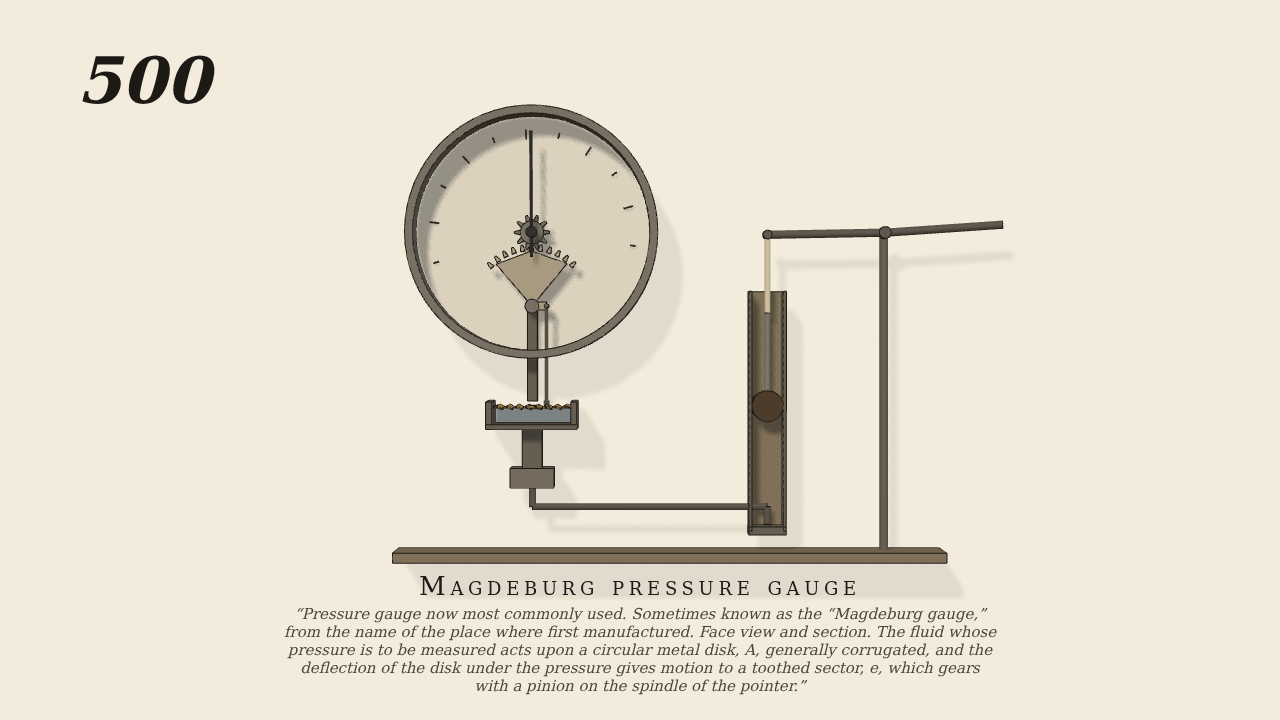
Pressure gauge now most commonly used. Sometimes known as the “Magdeburg gauge,” from the name of the place where first manufactured. Face view and section. The fluid whose pressure is to be measured acts upon a circular metal disk, A, generally corrugated, and the deflection of the disk under the pressure gives motion to a toothed sector, e, which gears with a pinion on the spindle of the pointer.
Only the input is driven; every other part of this model moves by physics (MuJoCo), and its ratios are measured. Run it live, change its parameters, or switch the friction off to see the output stop.
- Modelled as
- Face view, as Brown, with the disk drawn in section. A corrugated circular disk A, clamped at its rim, is pressed up by the fluid beneath it (lumped vessels; a hand pump's lever the only input); a stud on its centre works by a rod a toothed sector e, which gears with a pinion on the pointer's spindle against a hairspring.
- Measured
- The disk's deflection follows the pressure; the sector turns the pinion and the pointer moves over the dial, graduated every 2.5 kPa from a run of this model (within 0.06 rad).
- Notes
- The disk's stiffness is a spring on its centre; the section and face are combined in one view.
Film (MP4) · Still (PNG) · Spec (YAML) · Model (MJCF)