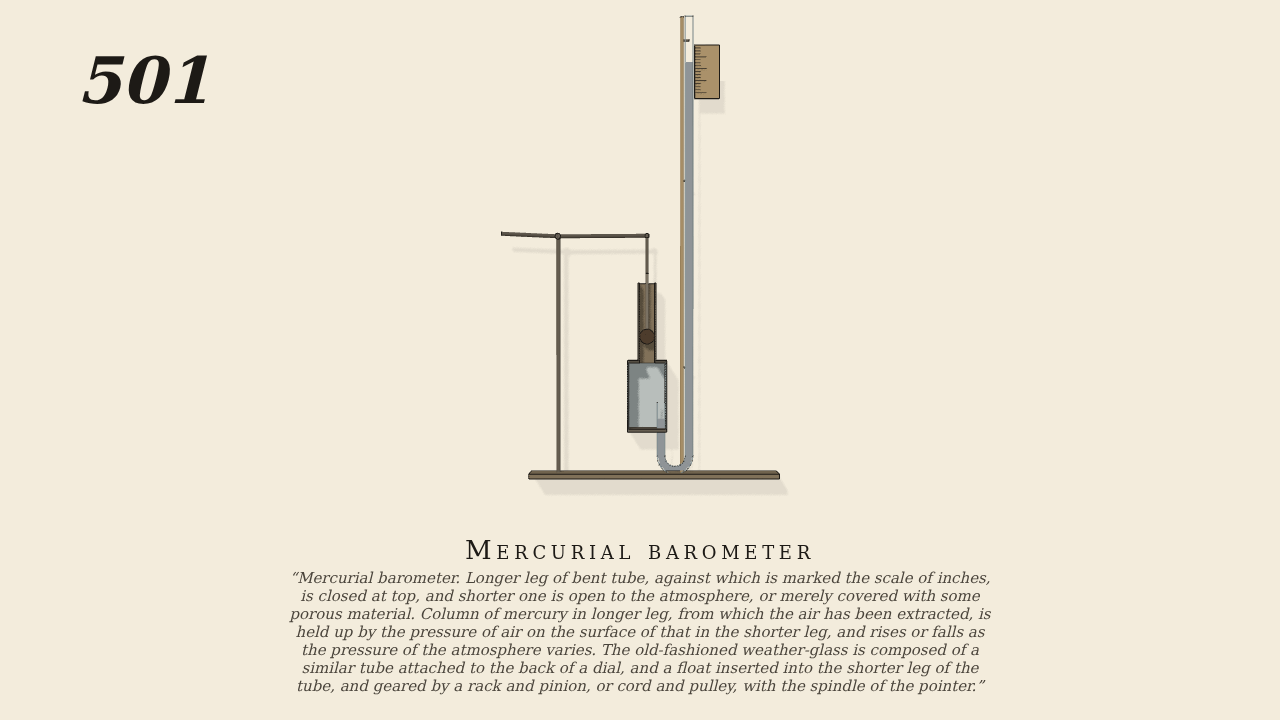
Mercurial barometer
Mercurial barometer. Longer leg of bent tube, against which is marked the scale of inches, is closed at top, and shorter one is open to the atmosphere, or merely covered with some porous material. Column of mercury in longer leg, from which the air has been extracted, is held up by the pressure of air on the surface of that in the shorter leg, and rises or falls as the pressure of the atmosphere varies. The old-fashioned weather-glass is composed of a similar tube attached to the back of a dial, and a float inserted into the shorter leg of the tube, and geared by a rack and pinion, or cord and pulley, with the spindle of the pointer.
Only the input is driven; every other part of this model moves by physics (MuJoCo), and its ratios are measured. Run it live, change its parameters, or switch the friction off to see the output stop.
- Modelled as
- Seen from in front, as Brown, gravity on. A bent glass tube: the long leg, closed at the top with a vacuum above the mercury, against a scale of inches; the short leg's mouth in a closed jar whose air a plunger, worked by a hand lever (the only input), compresses and rarefies by about 10 kPa either way (lumped vessels; a Torricelli vacuum above the column).
- Measured
- The mercury column in the long leg stands at the height the air's pressure holds up (13.56 kPa per 10 cm) and rises and falls with it (76.2 cm at 101325 Pa); the short leg's mercury moves the other way.
- Notes
- The weather's changes are made by a plunger in a jar; the weather-glass's float, dial and pointer are not built.
Film (MP4) · Still (PNG) · Spec (YAML) · Model (MJCF)