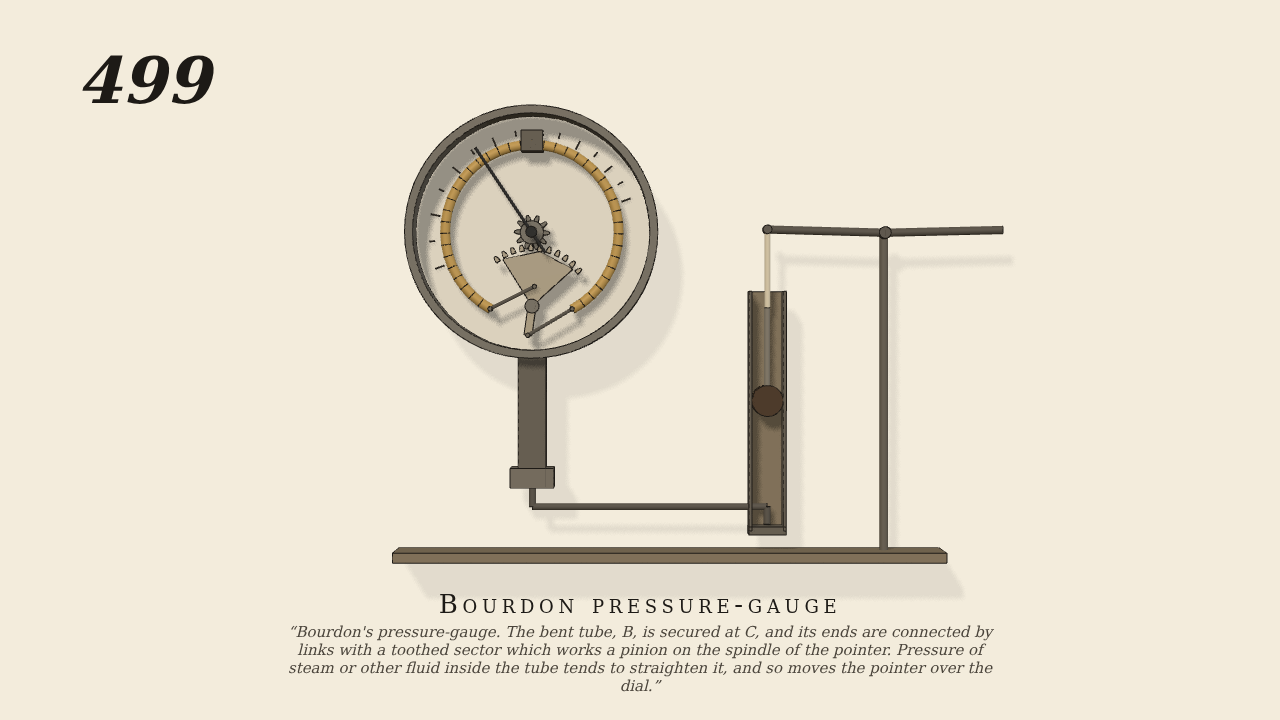
Aneroid gauge, known as the “Bourdon gauge,” from the name of its…
Aneroid gauge, known as the “Bourdon gauge,” from the name of its inventor, a Frenchman. B is a bent tube closed at its ends, secured at C, the middle of its length, and having its ends free. Pressure of steam or other fluid admitted to tube tends to straighten it more or less, according to its intensity. The ends of tube are connected with a toothed sector-piece gearing, with a pinion on the spindle of a pointer which indicates the pressure on a dial.
Only the input is driven; every other part of this model moves by physics (MuJoCo), and its ratios are measured. Run it live, change its parameters, or switch the friction off to see the output stop.
- Modelled as
- Seen face-on, as Brown, the glass off. The bent tube B is secured at C; each half is a chain of five short links hinged end to end, each hinge a spring and a piston on the bore, so the tube bends along its whole length. Its ends drive by links a toothed sector which works a pinion on the pointer's spindle against a hairspring. The bore's pressure comes from a hand pump (lever the only input), lumped vessels.
- Measured
- As the pressure rises every hinge opens with it and the tube straightens, its ends spreading; the links turn the sector and the pinion carries the pointer over the dial, graduated from a run of this model (within 0.16 rad, hysteresis about 0.04 rad).
- Notes
- The tube's elasticity is lumped in five sprung hinges per half; the pressure source is a hand pump rather than steam.
Film (MP4) · Still (PNG) · Spec (YAML) · Model (MJCF)