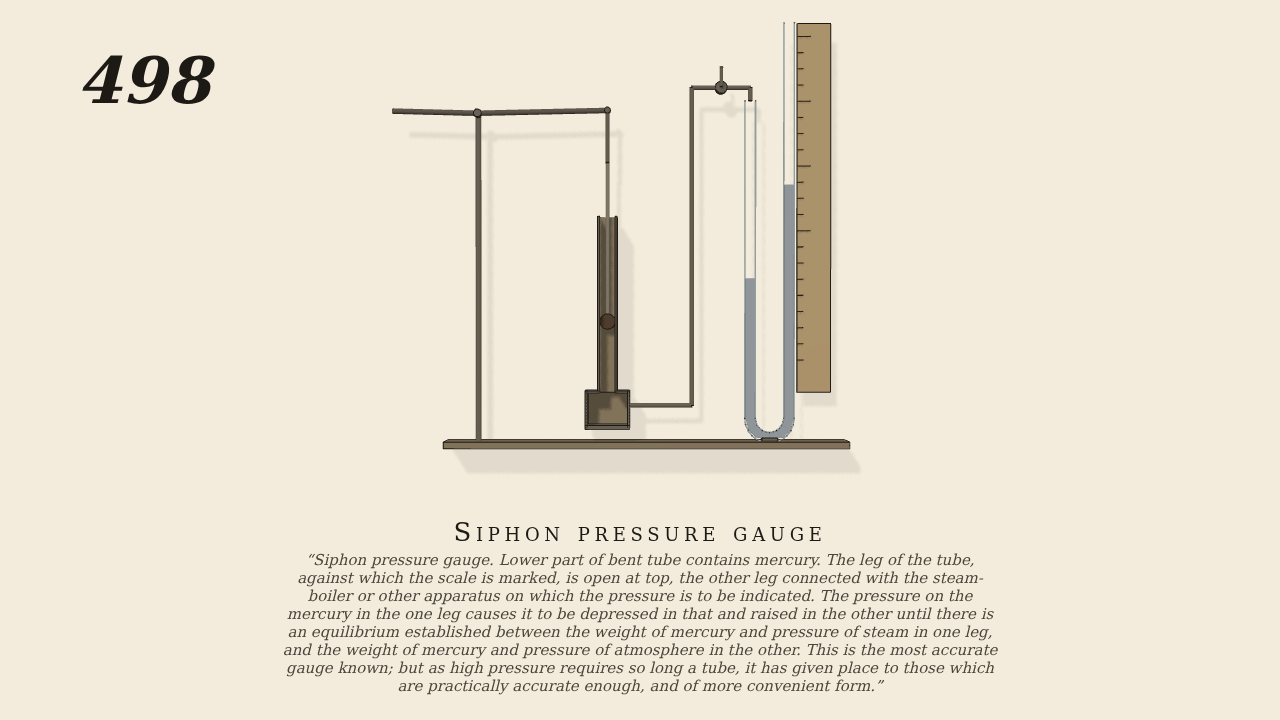
Siphon pressure gauge
Siphon pressure gauge. Lower part of bent tube contains mercury. The leg of the tube, against which the scale is marked, is open at top, the other leg connected with the steam-boiler or other apparatus on which the pressure is to be indicated. The pressure on the mercury in the one leg causes it to be depressed in that and raised in the other until there is an equilibrium established between the weight of mercury and pressure of steam in one leg, and the weight of mercury and pressure of atmosphere in the other. This is the most accurate gauge known; but as high pressure requires so long a tube, it has given place to those which are practically accurate enough, and of more convenient form.
Only the input is driven; every other part of this model moves by physics (MuJoCo), and its ratios are measured. Run it live, change its parameters, or switch the friction off to see the output stop.
- Modelled as
- Seen from the side, as Brown, gravity on. A U-tube of mercury, its long leg open to the air against a scale, its short leg piped to a closed vessel whose air is pressed by a plunger in a barrel worked by a hand lever (the only input). The pressure is lumped vessels (src/fluid/vessels.c).
- Measured
- Raising the pressure on the short leg depresses its mercury and raises the open leg's by the same amount; the difference of the levels reads the pressure (13.56 kPa per 10 cm), as Brown says.
- Notes
- The steam boiler is replaced by a hand pump's air; the mercury is drawn grey.
Film (MP4) · Still (PNG) · Spec (YAML) · Model (MJCF)