Fan-blower
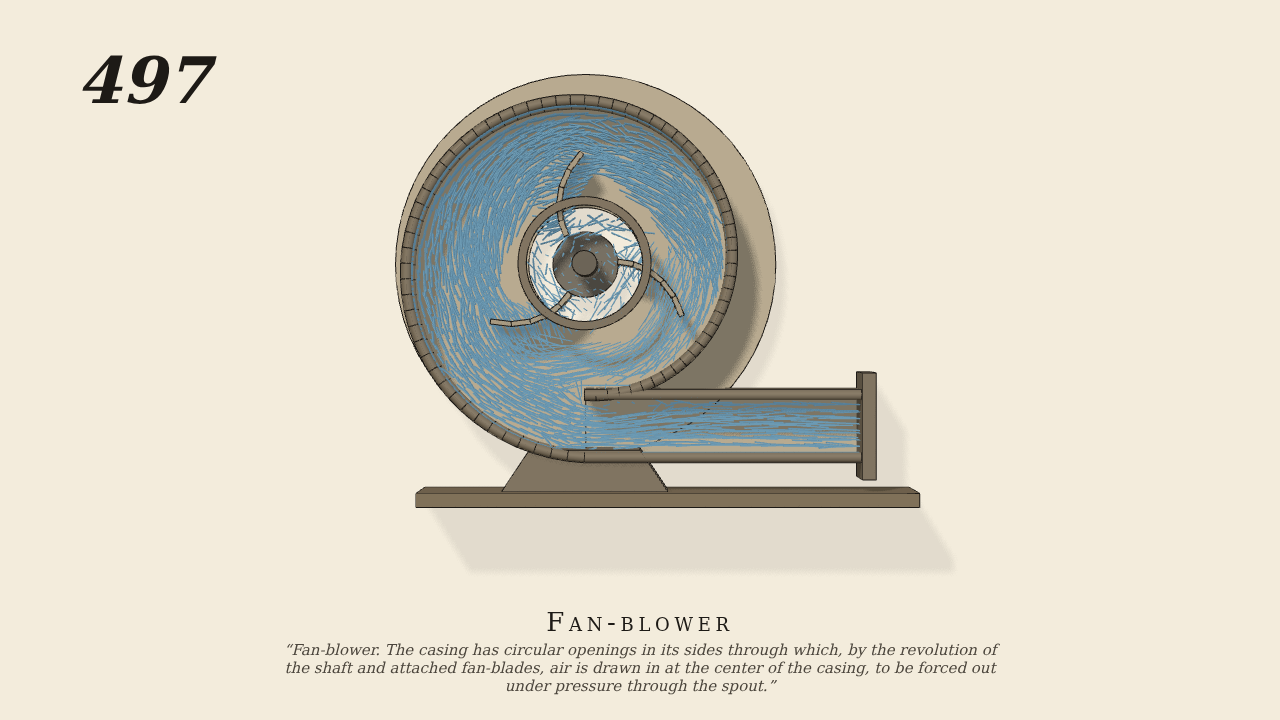
Fan-blower. The casing has circular openings in its sides through which, by the revolution of the shaft and attached fan-blades, air is drawn in at the center of the casing, to be forced out under pressure through the spout.
Only the input is driven; every other part of this model moves by physics (MuJoCo), and its ratios are measured. Run it live, change its parameters, or switch the friction off to see the output stop.
- Modelled as
- Seen along the shaft, as Brown. A three-bladed fan turns in a volute casing whose spout leaves tangentially at the bottom. The shaft turned at a steady 90 rpm counterclockwise (Brown's arrow) is the only input. The air is particles in the casing's mid-plane (src/fluid, density 1.204 kg/m^3), drawn in at the centre through the side openings and pushed only by the blades' collision with it; the walls of the volute, tongue and spout are colliding walls.
- Measured
- The blades fling the air round the volute and out of the spout: the outflow at 90 rpm is over ten times that with the fan stopped and 1.5 times that at 45 rpm. The air pushes back on the blades, and that push is the torque the shaft's drive supplies; at a thousandth of the air's density the load all but vanishes. Each particle is drawn as a streak along its own simulated velocity, so the swirl and the outflow are seen.
- Notes
- The air is a 2-D slice through the casing; its axial inflow through the side openings is a supply at the eye that only refills what the fan draws away.
Film (MP4) · Still (PNG) · Spec (YAML) · Model (MJCF)