Wet gas meter
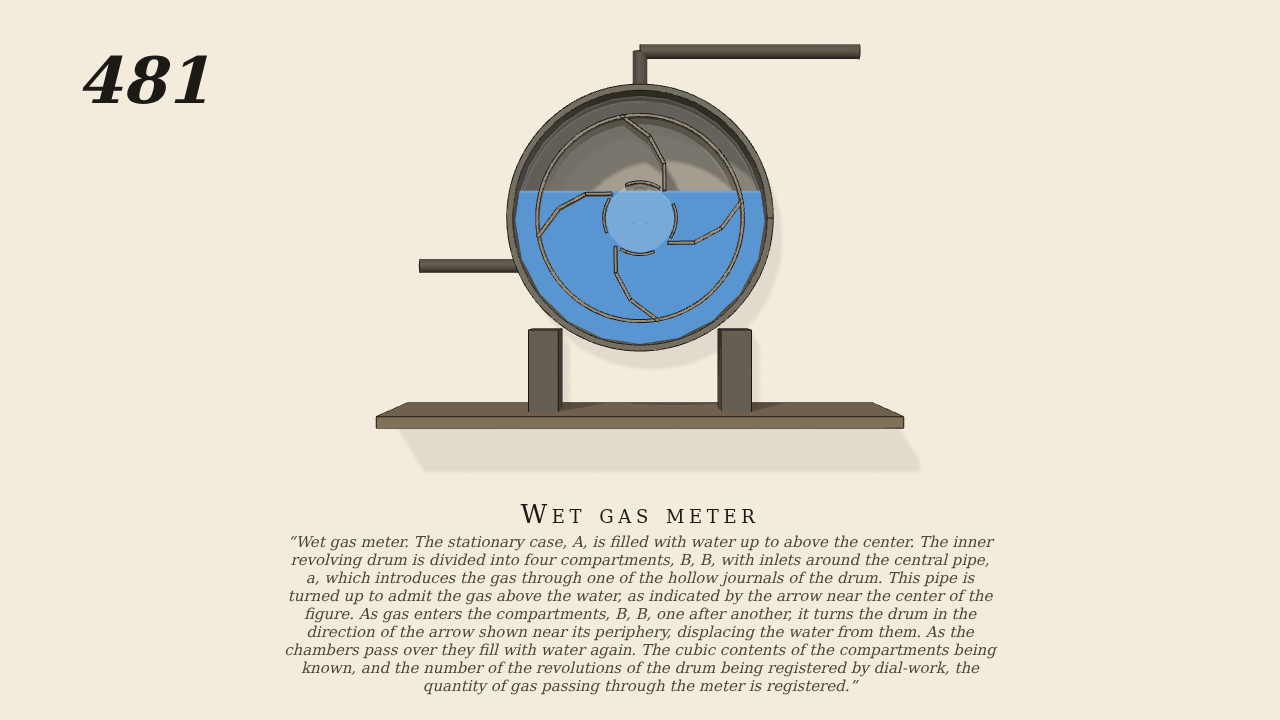
Wet gas meter. The stationary case, A, is filled with water up to above the center. The inner revolving drum is divided into four compartments, B, B, with inlets around the central pipe, a, which introduces the gas through one of the hollow journals of the drum. This pipe is turned up to admit the gas above the water, as indicated by the arrow near the center of the figure. As gas enters the compartments, B, B, one after another, it turns the drum in the direction of the arrow shown near its periphery, displacing the water from them. As the chambers pass over they fill with water again. The cubic contents of the compartments being known, and the number of the revolutions of the drum being registered by dial-work, the quantity of gas passing through the meter is registered.
Only the input is driven; every other part of this model moves by physics (MuJoCo), and its ratios are measured. Run it live, change its parameters, or switch the friction off to see the output stop.
- Modelled as
- Seen from in front, gravity on. A fixed case (34 cm) is filled with water to above its centre. A drum (28 cm) turns on a hub inside it, divided into four slanted compartments. Gas from the main (300 Pa, the only input) comes in at the centre and fills the compartment that is rising out of the water. The drum is a gas displacer (add-gas-displacers) carrying 2.44 L a turn from the inlet space to the outlet space at the gas's own density, and the pressure difference across it turns it.
- Measured
- The drum turns steadily at about 0.62 rad/s, with the inlet at about 247 Pa and the outlet at 73 Pa, passing about 0.29 g/s of gas. Each turn carries a known volume. The case's water and the gas are drawn from the sim state. The motion gate passes with no flags.
- Notes
- Grade B. The case's water level is held still: the water the partitions push aside is not modelled. The dial-work is not modelled. New primitive: add-gas-displacers.
Film (MP4) · Still (PNG) · Spec (YAML) · Model (MJCF)