Æolipile or Hero’s steam toy, described by Hero, of Alexandria,…
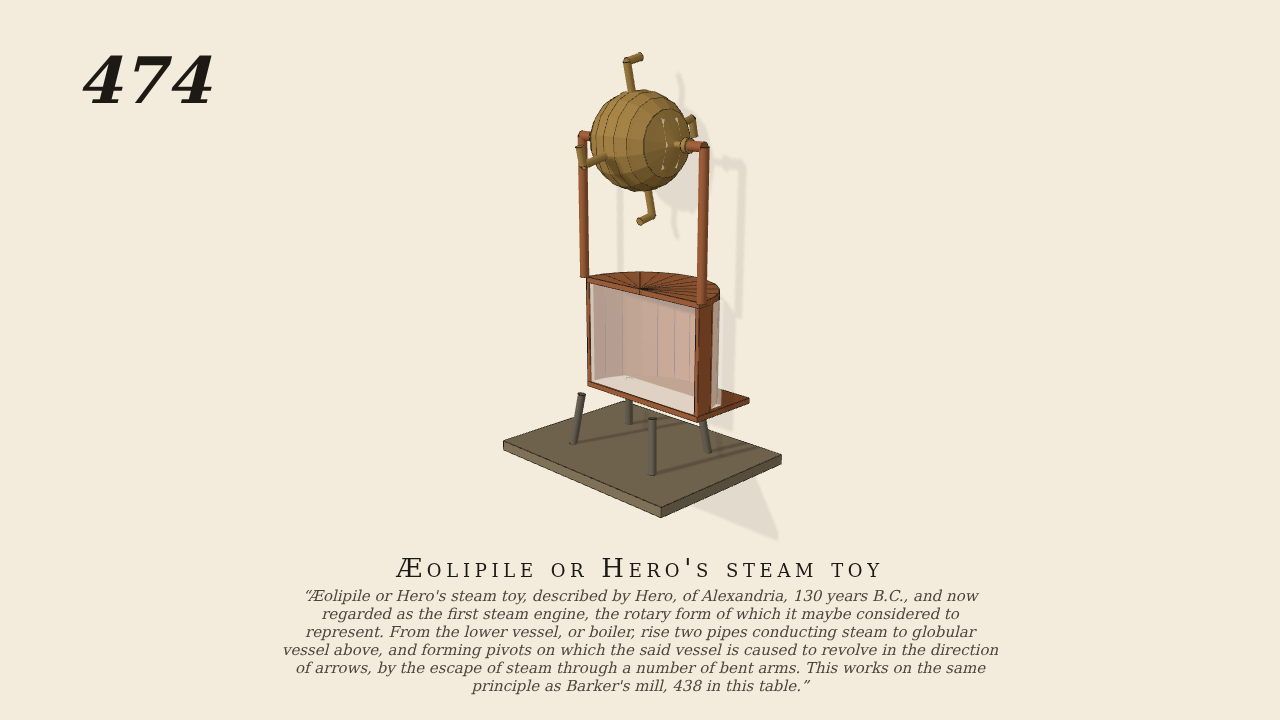
Æolipile or Hero’s steam toy, described by Hero, of Alexandria, 130 years B.C., and now regarded as the first steam engine, the rotary form of which it maybe considered to represent. From the lower vessel, or boiler, rise two pipes conducting steam to globular vessel above, and forming pivots on which the said vessel is caused to revolve in the direction of arrows, by the escape of steam through a number of bent arms. This works on the same principle as Barker’s mill, 438 in this table.
Only the input is driven; every other part of this model moves by physics (MuJoCo), and its ratios are measured. Run it live, change its parameters, or switch the friction off to see the output stop.
- Modelled as
- Seen from in front and to one side, the boiler cut away in half section, gravity on. The fire's raising of steam is the input: a supply at 6 kPa gauge through 0.8 cm² into the boiler, a lumped gas vessel. Its steam goes up two pipes of 0.5 cm² each into the globe (14 cm, 0.4 kg). The globe turns on its hollow journals. Its steam leaves by four bent arms, each a jet whose push is the flow times the steam's speed out of the mouth at the steam's own density (add-gas-jets). The push acts against the arm and against the journals' friction.
- Measured
- The globe turns the opposite way to its jets and settles at about 9.2 rad/s (about 1.5 rev/s). The boiler holds about 5.7 kPa and the globe about 5.4 kPa. The steam in the boiler is drawn and shaded by its pressure. The motion gate passes.
- Notes
- Grade B. The boiler's water and the fire are not modelled: the steam supply is the input, because the simulator has no heat. The jets are not drawn. The gate's WARN for "no water on screen" is expected for a steam toy.
Film (MP4) · Still (PNG) · Spec (YAML) · Model (MJCF)