Bilge ejector (Brear's patent)
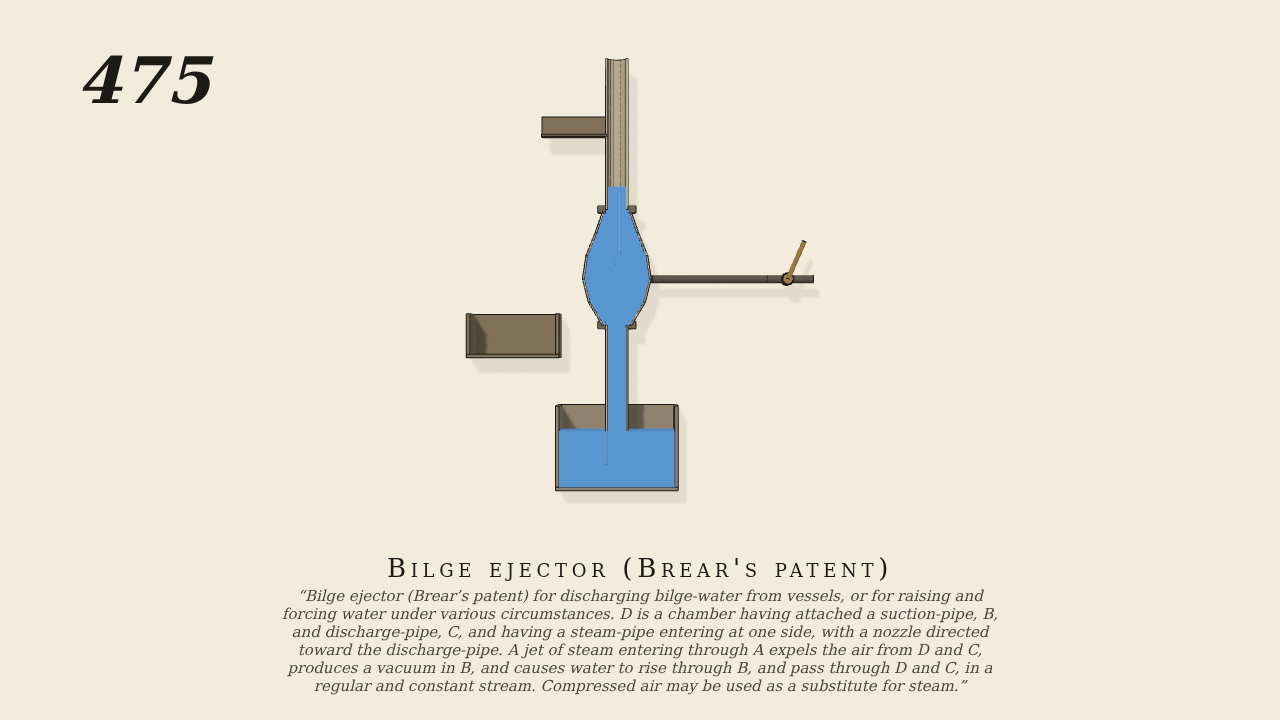
Bilge ejector (Brear’s patent) for discharging bilge-water from vessels, or for raising and forcing water under various circumstances. D is a chamber having attached a suction-pipe, B, and discharge-pipe, C, and having a steam-pipe entering at one side, with a nozzle directed toward the discharge-pipe. A jet of steam entering through A expels the air from D and C, produces a vacuum in B, and causes water to rise through B, and pass through D and C, in a regular and constant stream. Compressed air may be used as a substitute for steam.
Only the input is driven; every other part of this model moves by physics (MuJoCo), and its ratios are measured. Run it live, change its parameters, or switch the friction off to see the output stop.
- Modelled as
- In section, as Brown, gravity on. The chamber D with the suction pipe B down into the bilge tank, the discharge pipe C up to a spout over a tub, and the air pipe A entering D's side with a nozzle pointing up C. Lumped vessels model with the jet-pump primitive (openspec add-jet-pump: the throat's pressure rise mn (vn - vm) / A from the nozzle's momentum). The cock on A is the only input (opened once by hand and held): the jet drives the air out of D and C, B falls below the air's pressure, and the bilge water rises through B, D and C and runs from the spout.
- Measured
- Nothing runs while the cock is shut; opened, B falls to about -4.1 kPa and the spout runs steadily at 1.56 kg/s (tests/test_jet_pump.py, mass conserved). The motion gate passes; one WARN: 18% of on-screen motion is not near a simulated part (the drawn streams).
- Notes
- Grade B. Compressed air stands in for steam, as Brown allows (no condensation). The chamber is a turned bulb rather than Brown's casting; the spout and tub are added to show where the water goes.
Film (MP4) · Still (PNG) · Spec (YAML) · Model (MJCF)