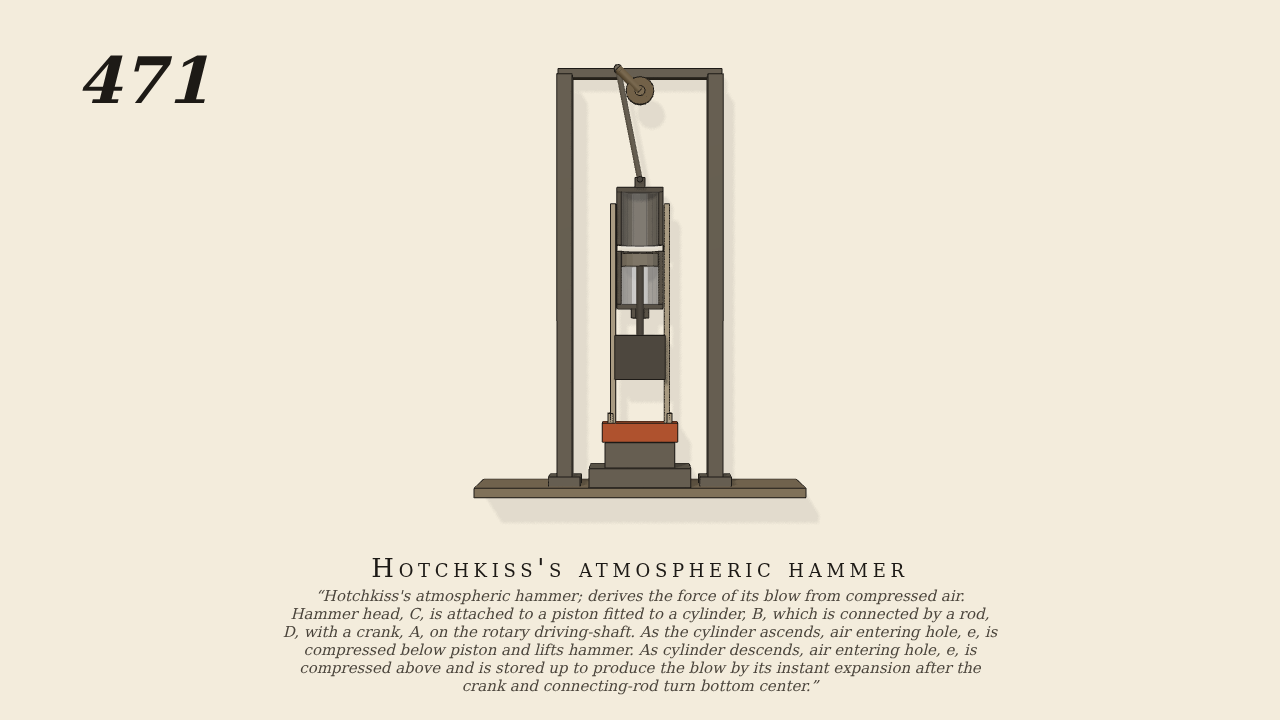
Hotchkiss's atmospheric hammer
Hotchkiss’s atmospheric hammer; derives the force of its blow from compressed air. Hammer head, C, is attached to a piston fitted to a cylinder, B, which is connected by a rod, D, with a crank, A, on the rotary driving-shaft. As the cylinder ascends, air entering hole, e, is compressed below piston and lifts hammer. As cylinder descends, air entering hole, e, is compressed above and is stored up to produce the blow by its instant expansion after the crank and connecting-rod turn bottom center.
Only the input is driven; every other part of this model moves by physics (MuJoCo), and its ratios are measured. Run it live, change its parameters, or switch the friction off to see the output stop.
- Modelled as
- Seen from in front, the cylinder cut away in half section, gravity on. The crank A (5 cm) on the overhead shaft turns at 150 rpm (the only drive) and by the rod D works the cylinder B (6 cm bore, 18 cm long) up and down in its guides. The hammer head C (12 kg) hangs on its rod from the piston inside the cylinder and slides in its own guides over the work. The air over and under the piston are two lumped gas vessels that the piston sweeps; each takes in or lets out air by the hole e in the cylinder's middle only while the piston is past it on the other side. So the cylinder rising shuts in and compresses the air under the piston, which lifts the hammer; the cylinder falling shuts in the air over it, which drives the hammer down on the work. Both airs are drawn in the moving cylinder, shaded by their pressures (add-steam-drawing, with sections carried by a body).
- Measured
- The hammer lifts about 14 cm off the work and strikes it once a turn, steady from the second turn; the piston moves −4.5 to +3.7 cm in the cylinder (allowed amplitude 2.5 to 6 cm), the air under it reaching about 145 kPa gauge and over it about 110 kPa. Gate: pytest 2 passed, lint 0 FAIL, motion gate pass; vitest tests/vsteam.test.ts passes (the airs stay in the moving bore, each up to its face of the piston).
- Notes
- Grade B. One WARN: no water visible, right for an air hammer. Isothermal lumped air. The model is tall and narrow in the frame.
Film (MP4) · Still (PNG) · Spec (YAML) · Model (MJCF)