Steam hammer
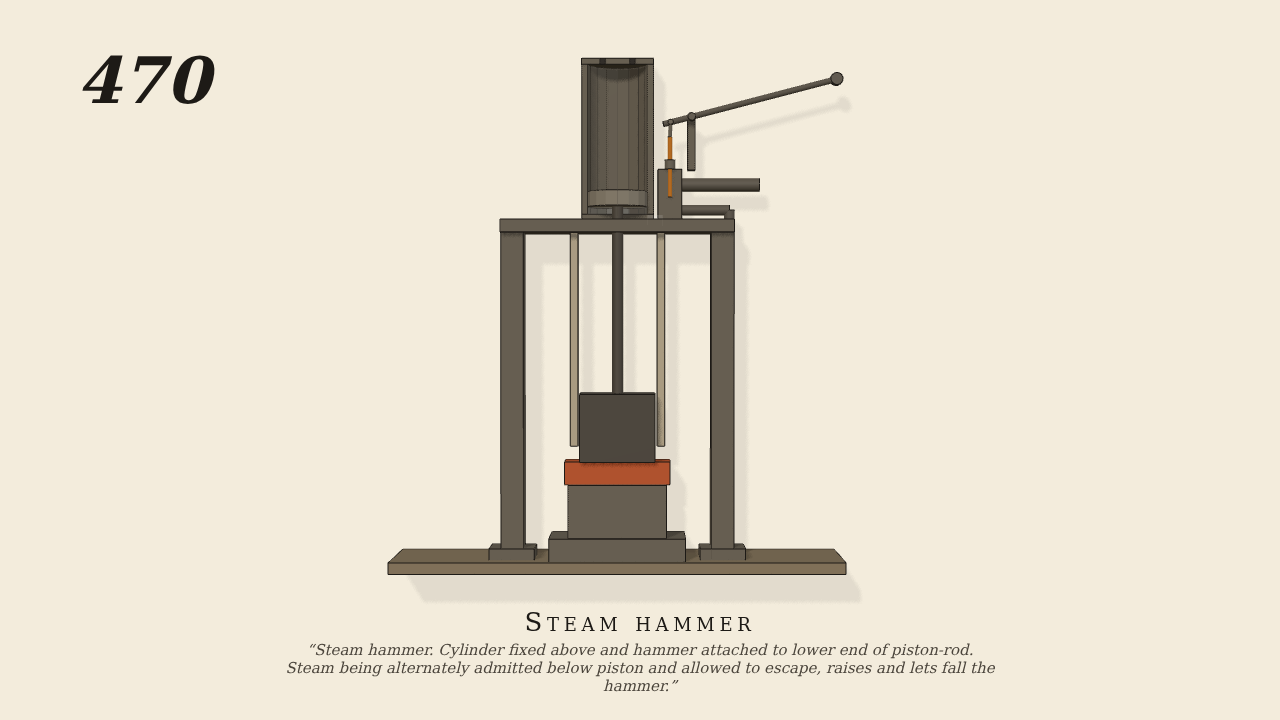
Steam hammer. Cylinder fixed above and hammer attached to lower end of piston-rod. Steam being alternately admitted below piston and allowed to escape, raises and lets fall the hammer.
Only the input is driven; every other part of this model moves by physics (MuJoCo), and its ratios are measured. Run it live, change its parameters, or switch the friction off to see the output stop.
- Modelled as
- Seen from in front, the cylinder and valve chest cut away in half section, gravity on. The cylinder (8 cm bore) is fixed on two standards over the anvil; the hammer (tup, piston rod and piston, 8 kg) slides in guides and rests on the hot bar on the anvil. The hammer-man's hand lever (swung ±0.28 rad at 0.7 Hz, the only drive) works the slide valve beside the cylinder: raised, it admits steam from the boiler (30 kPa gauge) under the piston; lowered, it lets that steam escape to the air. The space under the piston is a lumped gas vessel that the piston sweeps; its pressure lifts the hammer and, once the steam escapes, the hammer falls by its weight on the work. The steam under the piston is drawn from the vessel's state, cut at the piston's face and shaded by its pressure (new primitive, openspec/changes/add-steam-drawing).
- Measured
- The hammer rises 0 to 13.5 cm and falls on the bar every stroke of the lever, steady through the run (allowed amplitude 4.5 to 8 cm); the valve swings about −0.7 to 0.85 cm. Gate: pytest passed, lint 0 FAIL, motion gate pass; vitest tests/vsteam.test.ts passes (shade follows pressure, the steam stops at the piston's face, same state draws the same steam).
- Notes
- Grade B. One WARN: no water visible, which is right for a steam movement (the drawn steam is not counted as water). The steam is isothermal and lumped; no condensation. The space over the piston is open to the air by vents in the top cover.
Film (MP4) · Still (PNG) · Spec (YAML) · Model (MJCF)