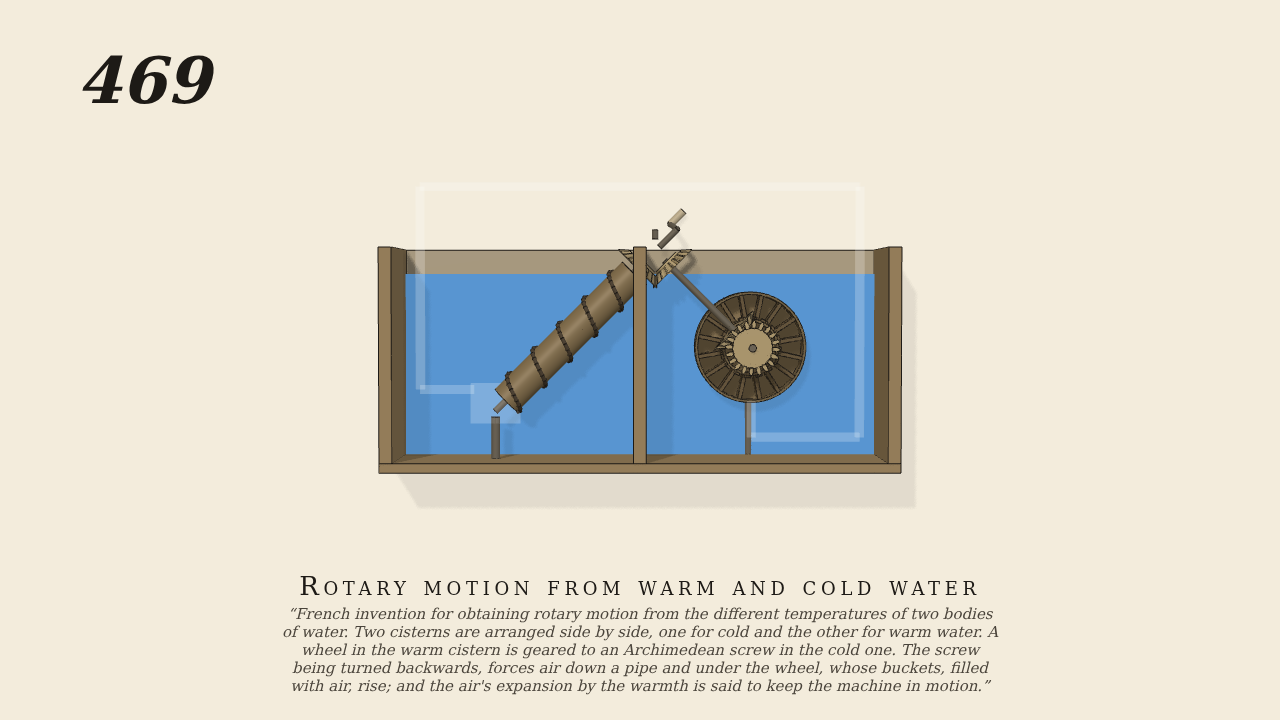
French invention for obtaining rotary motion from different…
French invention for obtaining rotary motion from different temperatures in two bodies of water. Two cisterns contain water: that in left at natural temperature and that in right higher. In right is a water-wheel geared with Archimedean screw in left. From spiral screw of the latter a pipe extends over and passes to the under side of wheel. Machine is started by turning screw in opposite direction to that for raising water, thus forcing down air, which ascends in tube, crosses and descends, and imparts motion to wheel; and its volume increasing with change of temperature, it is said, keeps the machine in motion. We are not informed how the difference of temperature is to be maintained.
Only the input is driven; every other part of this model moves by physics (MuJoCo), and its ratios are measured. Run it live, change its parameters, or switch the friction off to see the output stop.
- Modelled as
- Seen from in front, as Brown, gravity on. Cold cistern (left) with an inclined Archimedean screw, warm one (right) with a bucket wheel; the wheel's axle geared to the screw by a lay shaft and two pairs of mitre bevels (tooth contact only). The hand turns the screw backwards (velocity driver, 20 rpm, the only input). The screw and the wheel are gas displacers (add-vessel-displacers, add-gas-displacers): the screw carries the cold air over its cistern (283 K, a gas vessel open to the air) down a turn's pockets at a time (1500 cm3 a turn) into the bell and the pipe (a lumped gas vessel lying in the warm water, its air at 313 K); the buckets carry it up and out at the surface (1626 cm3 a turn). The pipe's pressure pushes the screw back and the wheel on by volume / 2 pi times it, so the wheel gives back more than the pumping costs (a hot-air engine). VW / VS is set so the pressure the mass balance gives equals the head over the wheel's lowest bucket (21 cm).
- Measured
- tests/test_rotary_warm_cold.py (pipe settles at p_atm (VS/VW)(TW/TC) - p_atm = 2.06 kPa within 8%, = the water's head; the wheel turns with the screw; with both cisterns cold the pipe stays below the head and the hand's mean torque is larger by over 0.02 N m)
- Notes
- Grade B. Lumped: the air pockets in the threads and buckets are not drawn (the pipe's air is, by its pressure); the head is not a vessel (it sets VW/VS); the cisterns' water is still, drawn to its volume as a slab behind the machine; nothing keeps the warm water warm. Gate WARN: vessel mass "not conserved" counts the air let out to the open air as held.
Film (MP4) · Still (PNG) · Spec (YAML) · Model (MJCF)