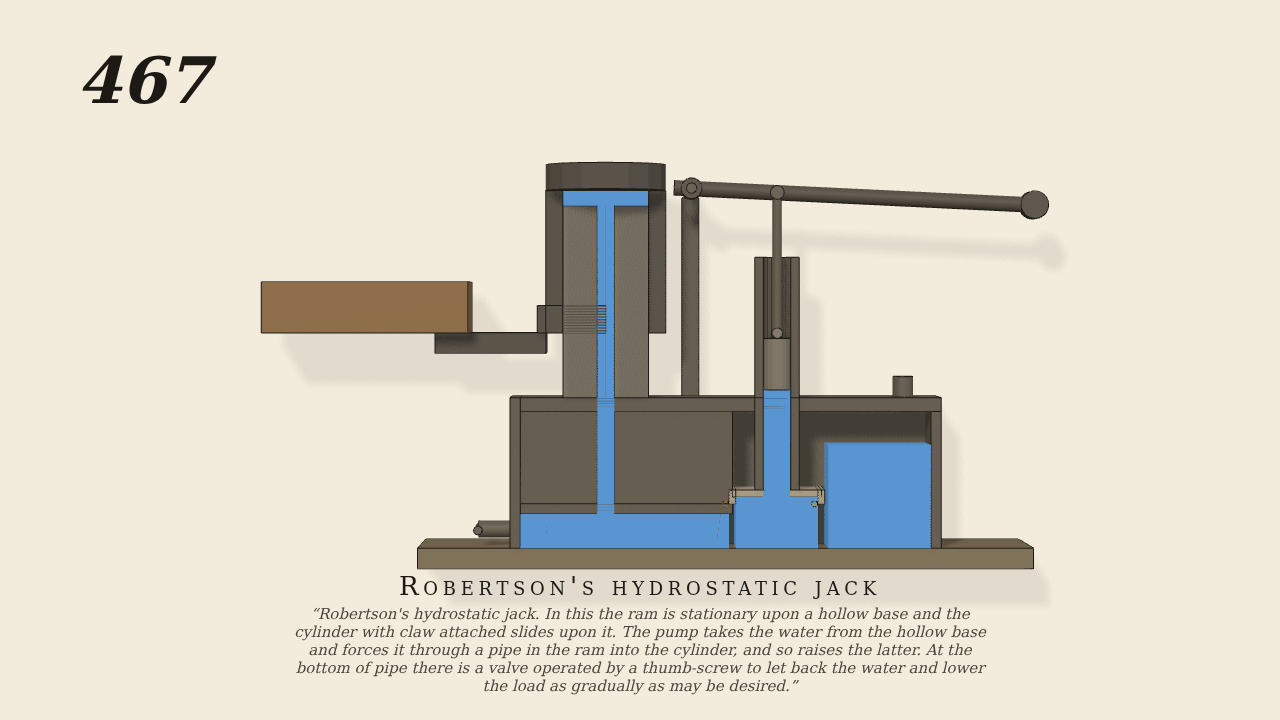
Robertson's hydrostatic jack
Robertson’s hydrostatic jack. In this the ram is stationary upon a hollow base and the cylinder with claw attached slides upon it. The pump takes the water from the hollow base and forces it through a pipe in the ram into the cylinder, and so raises the latter. At the bottom of pipe there is a valve operated by a thumb-screw to let back the water and lower the load as gradually as may be desired.
Only the input is driven; every other part of this model moves by physics (MuJoCo), and its ratios are measured. Run it live, change its parameters, or switch the friction off to see the output stop.
- Modelled as
- Seen in section, as Brown. The ram stands fixed on the hollow base and the cylinder, closed at its top, slides on it; its claw carries the load (a timber's end, 3 kg, resting on it). A hand lever (swung ±0.3 rad at 0.8 Hz, the only drive) works the pump in the base. The pump draws the water in the base (open to the air by its vent) through a flap in its head and forces it through a second flap along the passage and up the pipe in the ram into the cylinder over the ram's top, so the cylinder rises with the load. Flaps hang by their top edges and move only by their weight and the pressures on their faces.
- Measured
- The plunger strokes ±1.47 cm. The cylinder and load rise stroke by stroke, ending 2.86 to 3.01 cm up (allowed 1.5 to 8), at about 20 kPa under the cylinder; between strokes the delivery flap shuts and the load holds. Deepest contact 0.10 mm. Gate: pytest 2 passed, lint 0 FAIL, motion gate pass, no WARN.
- Notes
- Grade B+. The thumb-screw's let-back valve is drawn and stays shut through the run, so the lowering is not shown. Water is lumped: closed chambers for the passage, pipe and cylinder and for the pump, and the base's water as a level surface.
Film (MP4) · Still (PNG) · Spec (YAML) · Model (MJCF)