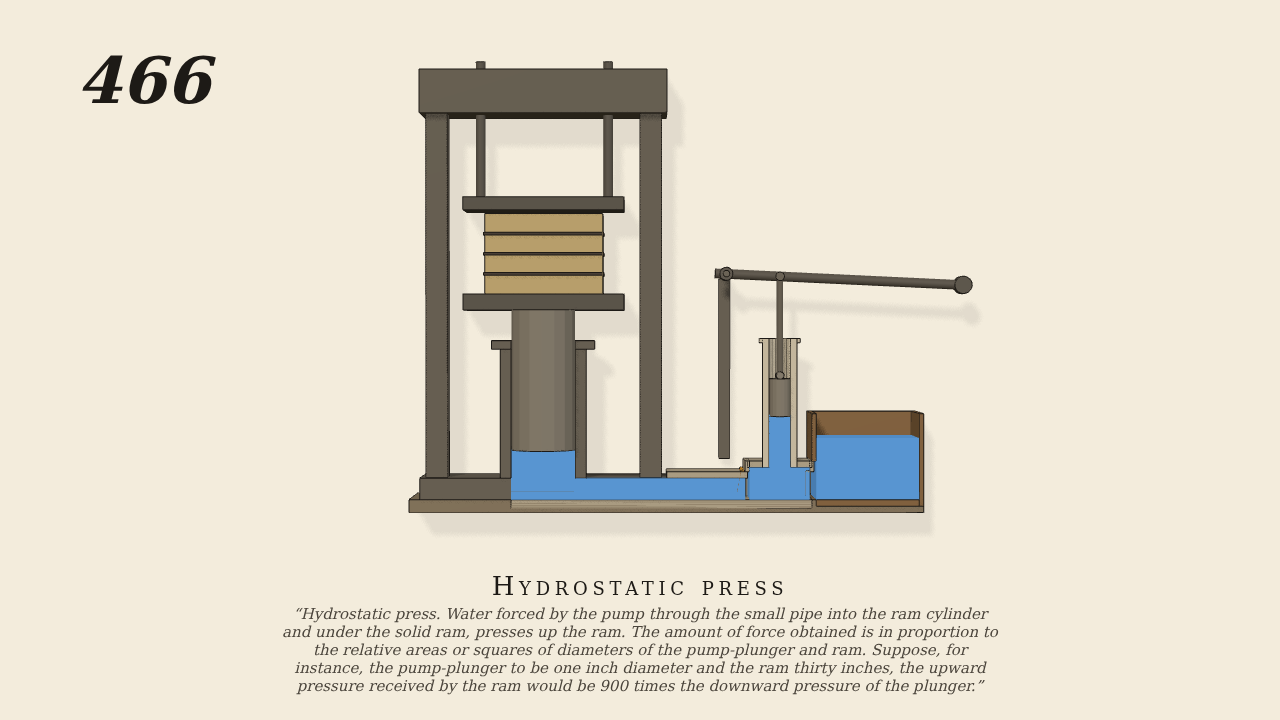
Hydrostatic press
Hydrostatic press. Water forced by the pump through the small pipe into the ram cylinder and under the solid ram, presses up the ram. The amount of force obtained is in proportion to the relative areas or squares of diameters of the pump-plunger and ram. Suppose, for instance, the pump-plunger to be one inch diameter and the ram thirty inches, the upward pressure received by the ram would be 900 times the downward pressure of the plunger.
Only the input is driven; every other part of this model moves by physics (MuJoCo), and its ratios are measured. Run it live, change its parameters, or switch the friction off to see the output stop.
- Modelled as
- Seen in section, as Brown. A hand lever (swung ±0.3 rad at 0.8 Hz, the only drive) works a small pump plunger (2 cm bore). The pump draws from a cistern through a suction flap and forces water through a delivery flap and the small pipe into the ram cylinder (6 cm bore) under the solid ram. The ram carries a platen up against the bale, which presses a follower plate held down by a stiff spring standing for the goods. Flaps hang by their top edges and move only by their weight and the pressures on their faces.
- Measured
- The plunger strokes ±1.47 cm. The ram rises stroke by stroke and ends 3.13 to 3.29 cm up (allowed 2 to 9). Once the bale meets the follower the ram-cylinder pressure climbs from about 7 to 28 kPa, and the ram holds between strokes because the delivery flap shuts. Gate: pytest 2 passed, lint 0 FAIL, motion gate pass (WARN: the base reaches the top of the title text in every frame).
- Notes
- Grade B. Brown's 1 inch plunger and 30 inch ram (area ratio 900) are scaled to 2 cm and 6 cm (ratio 9) so the ram's rise shows in the clip. The follower spring stands for the goods being pressed. Water is lumped: closed chambers, pipes and the cistern's level surface.
Film (MP4) · Still (PNG) · Spec (YAML) · Model (MJCF)