Balance pumps
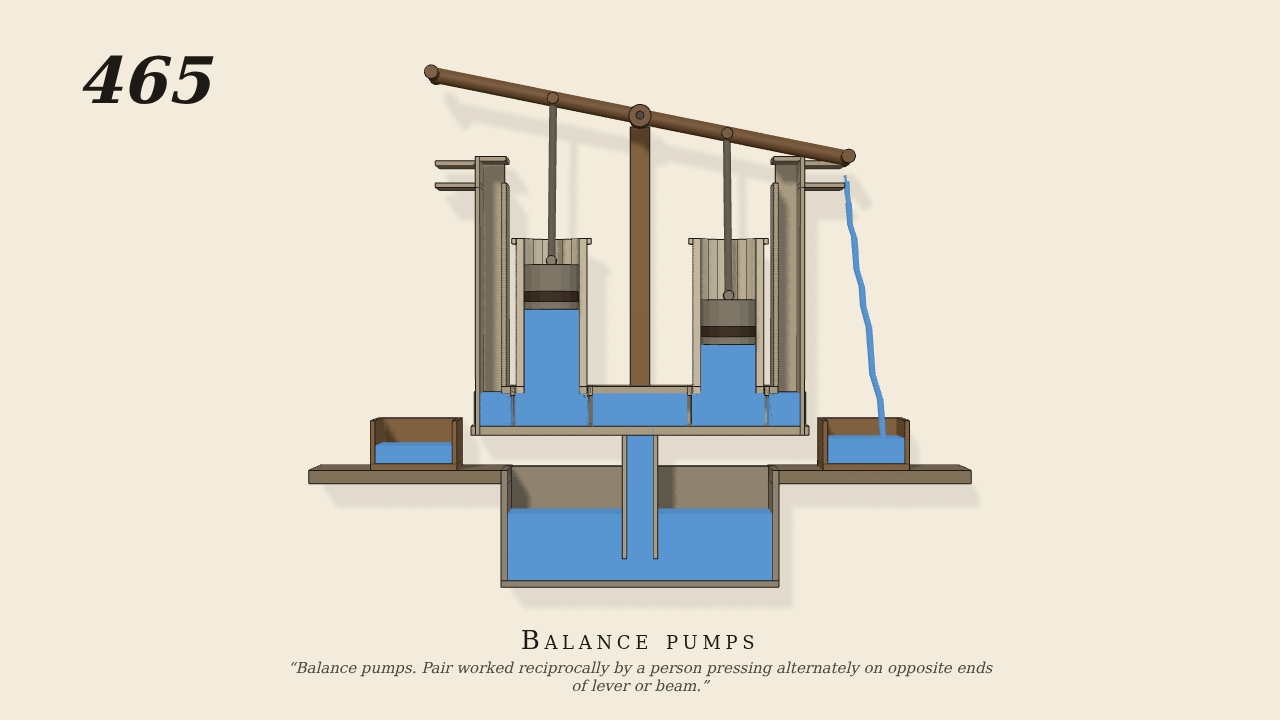
Balance pumps. Pair worked reciprocally by a person pressing alternately on opposite ends of lever or beam.
Only the input is driven; every other part of this model moves by physics (MuJoCo), and its ratios are measured. Run it live, change its parameters, or switch the friction off to see the output stop.
- Modelled as
- Two force pumps cut away in half section, with a beam on a post between them. A rod from each plunger is pinned to the beam 8 cm either side of the fulcrum, and the person presses its ends down in turn (the beam swung ±0.2 rad, the only drive), so one plunger rises as the other falls. Each barrel stands on a head with two flaps hung by their top edges: the inner one lets water in from a pocket fed by the suction pipe from the well; the outer one lets it out to a riser whose spout pours into a trough, and the trough's waste runs back to the well. Flaps move only by their weight and the pressures on their faces.
- Measured
- The plungers stroke ±1.59 cm in opposition. Each pump in turn draws about 100 g/s at mid-stroke and delivers about 100 g/s up its riser while the other draws, about 31 g/s each on average. The troughs fill slowly against their waste. Motion gate pass (WARN: single-frame flicker in the falling spout streams).
- Notes
- The person is the driven beam. Water is lumped: closed chambers under the plungers, full pockets and pipes, the risers as pipes with inertia, and level surfaces in the well and troughs, plus drawn streams.
Film (MP4) · Still (PNG) · Spec (YAML) · Model (MJCF)