Hero's fountain
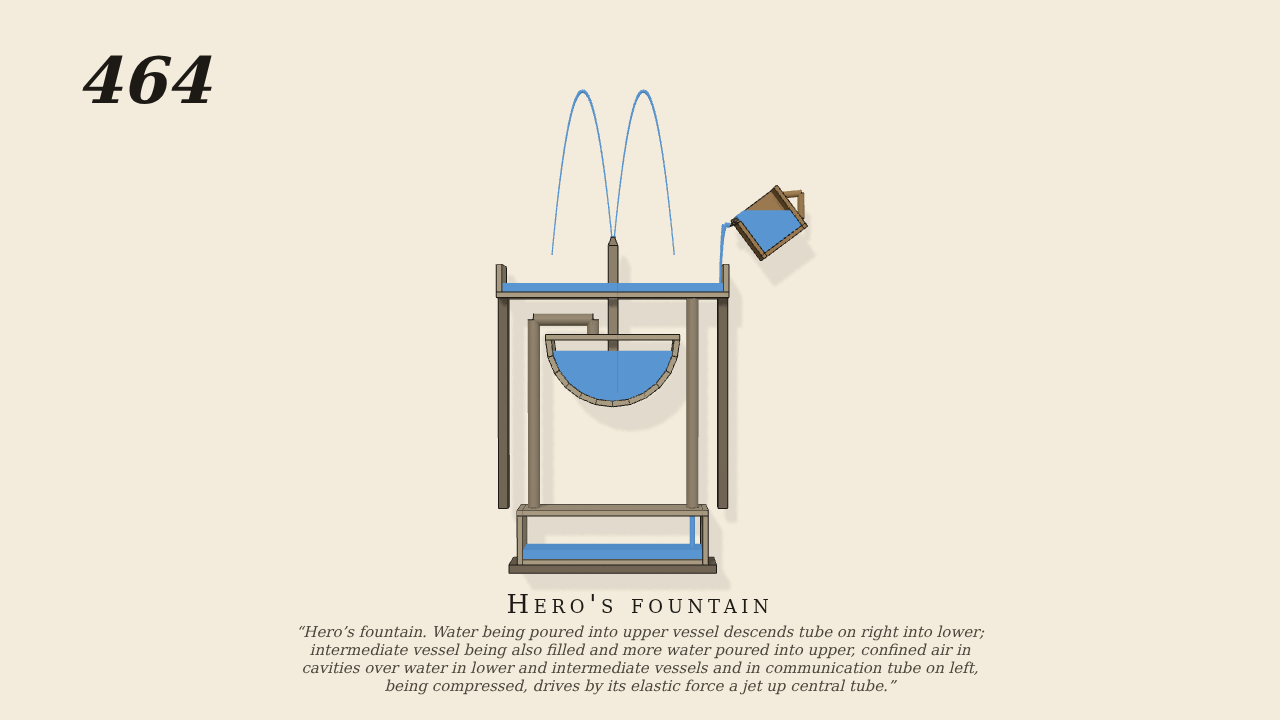
Hero’s fountain. Water being poured into upper vessel descends tube on right into lower; intermediate vessel being also filled and more water poured into upper, confined air in cavities over water in lower and intermediate vessels and in communication tube on left, being compressed, drives by its elastic force a jet up central tube.
Only the input is driven; every other part of this model moves by physics (MuJoCo), and its ratios are measured. Run it live, change its parameters, or switch the friction off to see the output stop.
- Modelled as
- Brown's figure, gravity on: an open basin on top, a closed bowl in the middle and a closed vessel at the foot. A tube runs from the basin down to the foot vessel; an air tube from the foot vessel's top up into the bowl's top; the jet pipe from low in the bowl up through the basin to a nozzle. Water poured into the basin runs down, squeezes the foot vessel's air into the bowl, and that air drives the bowl's water up the jet. The input is a jug, tipped on its lip by the hand (1.2 rad out and back over the run), pouring into the basin as Brown has it; the hand only turns the jug, and every flow is from levels, pressures and orifices.
- Measured
- The jug pours up to about 54 g/s while tipped (about 140 g in all); the basin rises from 41.5 to 42.1 and feeds the foot vessel at about 11 g/s; the bowl's air pressure (about 3.8 kPa) lifts two jets of about 5.5 g/s each above the basin, falling back into it, while the bowl's water level falls. Motion gate pass (WARN: the jets' falling water counts as motion away from the parts).
- Notes
- The jug is added as the moving input (Brown's text: water being poured). Water is lumped: level surfaces in the jug, basin and vessels, and drawn streams; jets are inertial orifice flows. Air passes between the closed chambers without compression losses beyond the chamber model.
Film (MP4) · Still (PNG) · Spec (YAML) · Model (MJCF)