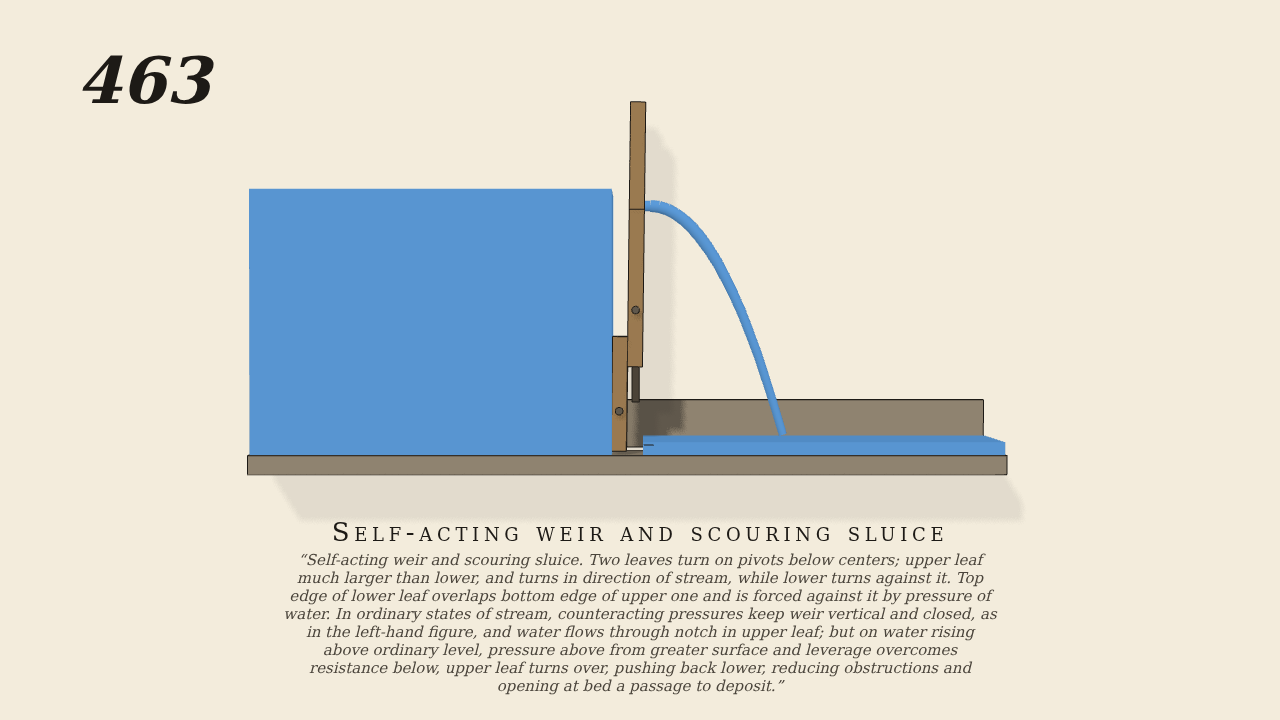
Self-acting weir and scouring sluice
Self-acting weir and scouring sluice. Two leaves turn on pivots below centers; upper leaf much larger than lower, and turns in direction of stream, while lower turns against it. Top edge of lower leaf overlaps bottom edge of upper one and is forced against it by pressure of water. In ordinary states of stream, counteracting pressures keep weir vertical and closed, as in the left-hand figure, and water flows through notch in upper leaf; but on water rising above ordinary level, pressure above from greater surface and leverage overcomes resistance below, upper leaf turns over, pushing back lower, reducing obstructions and opening at bed a passage to deposit.
Only the input is driven; every other part of this model moves by physics (MuJoCo), and its ratios are measured. Run it live, change its parameters, or switch the friction off to see the output stop.
- Modelled as
- Brown's section across the stream, which runs left to right, gravity on. The lower leaf (9.1 high) turns on a pivot 3.2 up it; the upper (21 long, a notch in its top part) on one 4.5 up it, its foot behind the lower leaf's top. The pond presses each leaf strip by strip: half-cm pistons at each strip's height (the pressure there, its area and arm about the pivot), so the water above a pivot turns that leaf's top downstream and the water below it the other way; the lower leaf's push on the upper leaf's foot is real contact. A river runs into the pond faster than the notch passes it, so the pond rises; this is the only input, and nothing drives the leaves.
- Measured
- Held shut, with the notch running (45–100 g/s), while the pond rises from 20.0 to about 22.6. Then the upper leaf turns over to 0.52 rad, pushing the lower leaf's top back upstream to its stop (−0.45 rad). Water runs over the turned leaf, then out at the bed under the lower leaf (about 990 g/s at first), and the pond falls to about 9 by 14 s. Motion gate pass (WARN: the falling water surfaces count as motion away from the parts, and a stream flickers for one frame).
- Notes
- Each strip's pressure acts at its height when the leaf stands upright; the strips do not follow the leaf as it turns. The lower leaf's travel ends at a stop. The leaves stay open once turned (the run ends before any flood would pass). Water is lumped: a level surface in the pond and the tail, plus drawn streams.
Film (MP4) · Still (PNG) · Spec (YAML) · Model (MJCF)