Chain pump
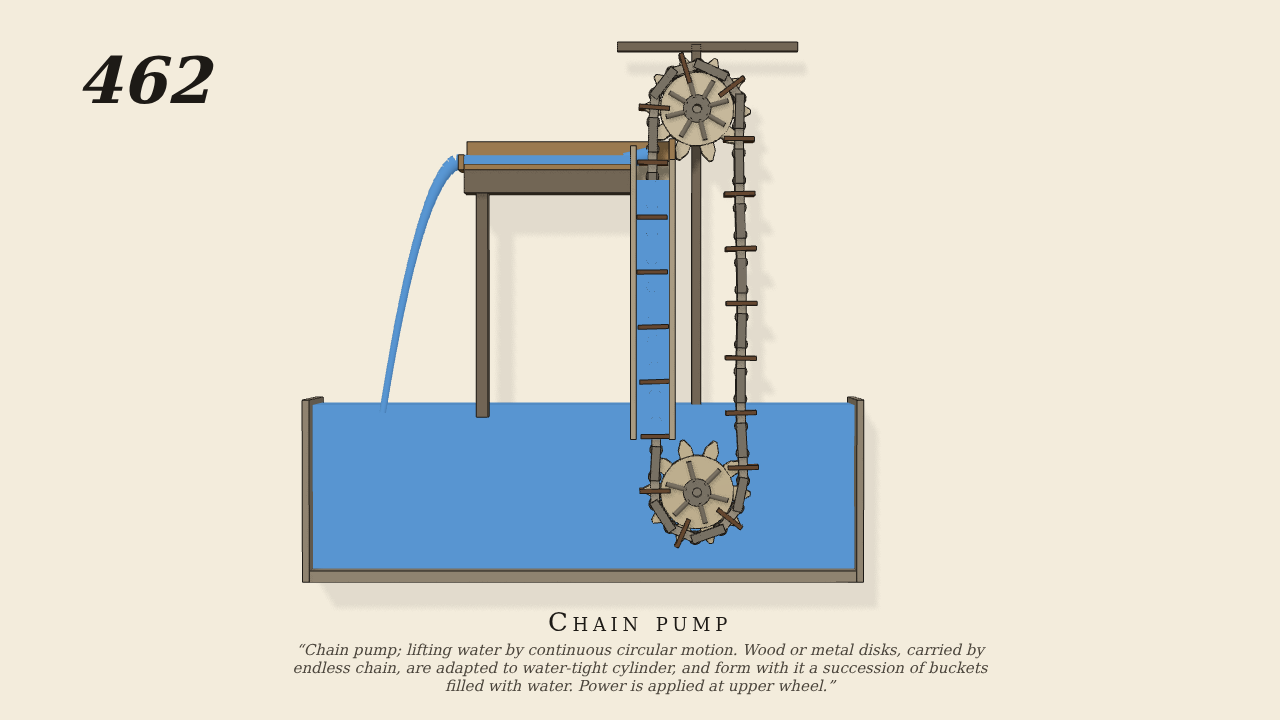
Chain pump; lifting water by continuous circular motion. Wood or metal disks, carried by endless chain, are adapted to water-tight cylinder, and form with it a succession of buckets filled with water. Power is applied at upper wheel.
Only the input is driven; every other part of this model moves by physics (MuJoCo), and its ratios are measured. Run it live, change its parameters, or switch the friction off to see the output stop.
- Modelled as
- Seen from in front, the pipe cut in section, gravity on. Two sprocket-wheels of 10 teeth, one 33.6 above the other, and an endless chain of 38 real links on rollers, a disk on every other link. The upper wheel is turned at 30 rpm, the only drive, and drives the chain by its teeth; the lower wheel, under the well's water, is turned only by the chain. The rising run goes up the pipe, each pair of disks holding a bucket of water: the upper wheel is a screw that carries about 130 cm^3 a turn from the well up 22.5 into the pipe's column and is loaded by that lift. The column spills over the pipe's top into the head, runs along the trough and falls off its spout back into the well.
- Measured
- Upper wheel 3.11 rad/s (30 rpm under load), lower wheel turned by the chain at ratio 1.00; about 60 g/s lifted over the pipe's top and off the spout; 4 g/s leaks back past the disks. Motion gate pass.
- Notes
- The water is lumped: the pipe's column and the head are level surfaces, and the lift is a per-turn volume on the upper wheel, not water carried by each disk. The spout's stream falls back into the same well.
Film (MP4) · Still (PNG) · Spec (YAML) · Model (MJCF)