Old rotary pump
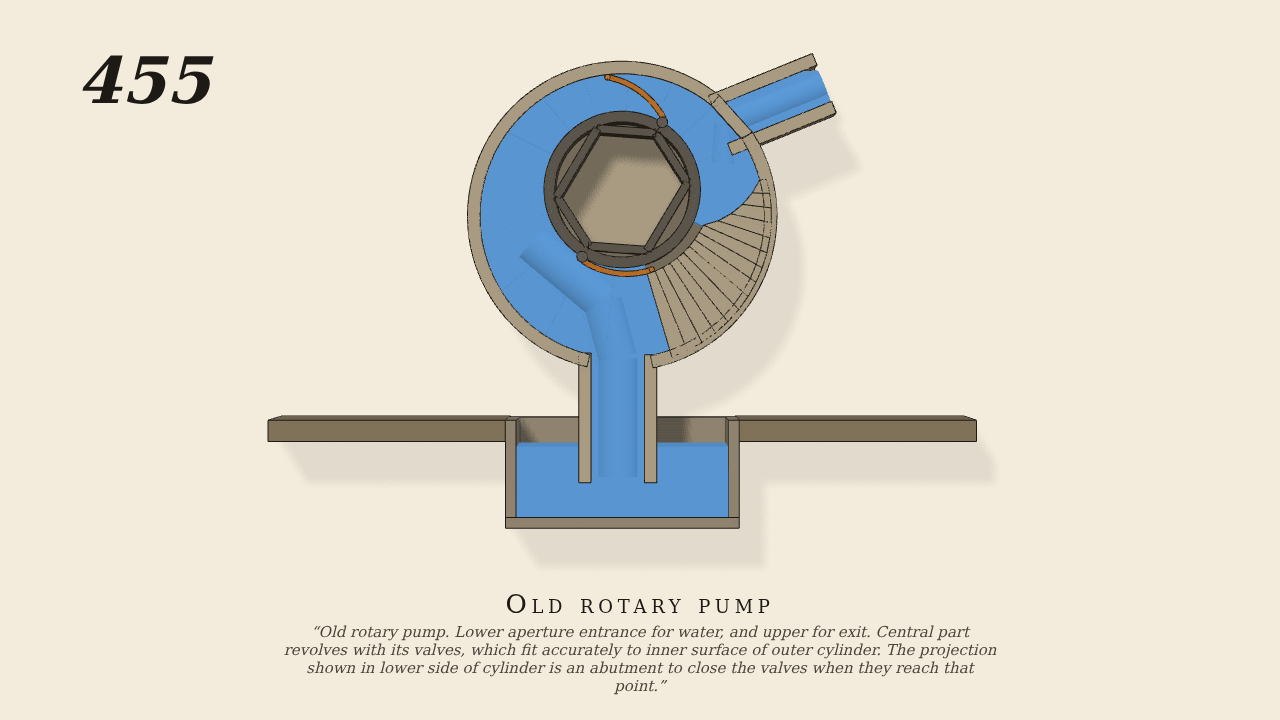
Old rotary pump. Lower aperture entrance for water, and upper for exit. Central part revolves with its valves, which fit accurately to inner surface of outer cylinder. The projection shown in lower side of cylinder is an abutment to close the valves when they reach that point.
Only the input is driven; every other part of this model moves by physics (MuJoCo), and its ratios are measured. Run it live, change its parameters, or switch the friction off to see the output stop.
- Modelled as
- Seen from in front, cut in section, as Brown. The central part, a drum on an axle 1.5 cm above the outer cylinder's centre, is turned clockwise at 20 rpm (the only drive). Its two valves are curved leaves hinged on its rim at opposite seats, trailing; each is pressed out by its spring and its edge (a colliding round bar) rides the cylinder's inside. The abutment in the lower side (colliding) has a ramp that folds a valve flat onto the rim; the valve springs out again over the entrance. The water is lumped vessels: `lo` is the entrance pipe and the chamber behind the valve, `hi` the chamber ahead of it and the exit, both full. The drum is a displacer between them (new primitive, OpenSpec add-vessel-displacers): a turn carries 373 cm^3 from `lo` to `hi`, and the two pressures load it. The exit delivers 60 cm up with inertia; a 0.05 cm^2 leak models the fit.
- Measured
- the drum runs at 2.07 rad/s, 113 g/s up the entrance and out of the exit (123 swept less 10 leaked), with `hi` at +4.0 kPa and `lo` at -1.9 kPa. Both valves fold at the abutment and spring out (0.07..1.6 rad). Gate: pass (no WARN).
- Notes
- Grade B. The water's push on the valves themselves is not modelled (springs hold them out). The swept volume is the mean over the valve's path, so the drum's flow does not pulse as each valve passes the ports.
Film (MP4) · Still (PNG) · Spec (YAML) · Model (MJCF)