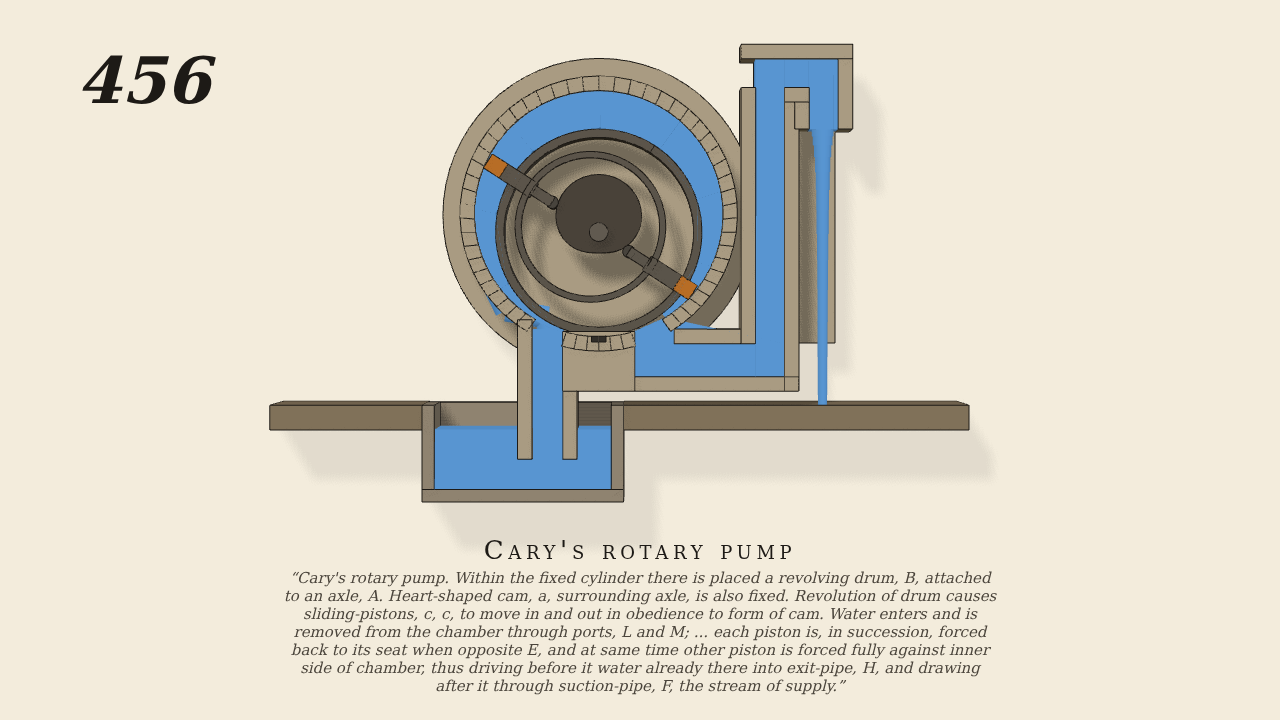
Cary's rotary pump
Cary’s rotary pump. Within the fixed cylinder there is placed a revolving drum, B, attached to an axle, A. Heart-shaped cam, a, surrounding axle, is also fixed. Revolution of drum causes sliding-pistons, c, c, to move in and out in obedience to form of cam. Water enters and is removed from the chamber through ports, L and M; the directions are indicated by arrows. Cam is so placed that each piston is, in succession, forced back to its seat when opposite E, and at same time other piston is forced fully against inner side of chamber, thus driving before it water already there into exit-pipe, H, and drawing after it through suction-pipe, F, the stream of supply.
Only the input is driven; every other part of this model moves by physics (MuJoCo), and its ratios are measured. Run it live, change its parameters, or switch the friction off to see the output stop.
- Modelled as
- Seen from in front, cut in section, as Brown. The drum B on its axle A is turned clockwise at 20 rpm (the only drive). The pistons c, c are the two ends of one bar sliding across the drum; its loop goes round the fixed cam a, and two colliding rollers in the loop bear on the cam from either side, so the cam drives the bar both ways: each piston stands fully out (1.8 cm) at the top and is forced back to its seat opposite E. The fixed cylinder's inside follows the pistons' path. Water is lumped vessels: `lo` is the suction pipe F (from a well) and the chamber behind the piston that is out, `hi` the chamber ahead of it, the port M and the exit pipe H up over its gooseneck, both full; the drum is a displacer between them (91 cm³ a turn), loaded by the two pressures, with a small leak past the fit. The spout pours into the air and falls.
- Measured
- Drum 2.09 rad/s (20 rpm); the bar slides 0.01–1.79 cm (stroke 1.8, cam 2 × 0.9); 28 g/s up F and out of the spout (30 swept, 2.3 leaked back); lo −1.6 kPa. Motion gate pass.
- Notes
- Brown's cam is heart-shaped; this one is a limaçon r = 1.9 + 0.9 sin about the axle (constant breadth, so the two rollers hold the bar both ways). The water's flow is the mean of the sweep, so it does not pulse as each piston enters and leaves the working way; the chamber's water is drawn as one ring the pistons pass in front of.
Film (MP4) · Still (PNG) · Spec (YAML) · Model (MJCF)