Holly’s patent double-elliptical rotary engine
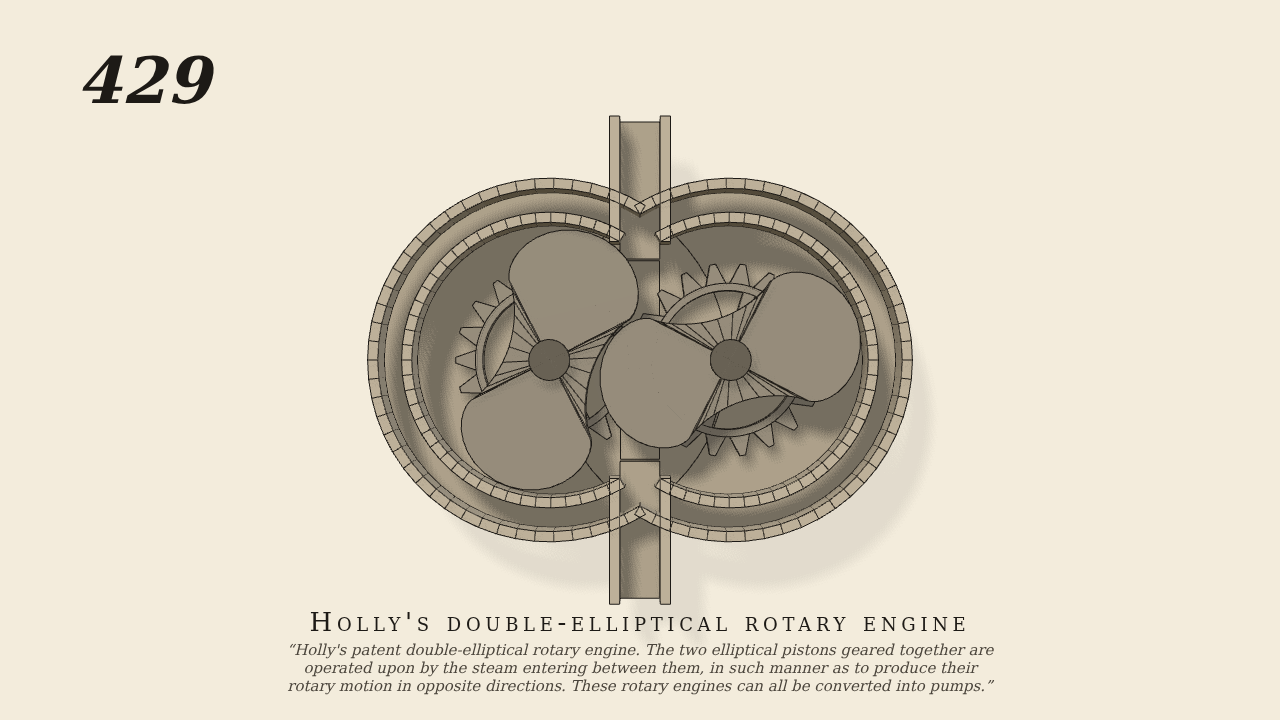
Holly’s patent double-elliptical rotary engine. The two elliptical pistons geared together are operated upon by the steam entering between them, in such manner as to produce their rotary motion in opposite directions. These rotary engines can all be converted into pumps.
Only the input is driven; every other part of this model moves by physics (MuJoCo), and its ratios are measured. Run it live, change its parameters, or switch the friction off to see the output stop.
- Modelled as
- Brown's section through the cylinder, no gravity. Two equal two-lobed pistons turn on shafts 8 cm apart, each in its own bore of the figure-of-eight cylinder, the inlet at the top between them and the outlet at the bottom. Their outlines are conjugate (epicycloid lobes and hypocycloid pockets on the pitch circle), so as they turn 1:1 opposite ways each lobe rolls in the other's pocket, just clear, and the lobes' tips sweep the bores. They are geared together by two equal 20-tooth wheels behind the pistons, in real tooth contact, the only contact. The steam entering between them (the one driven input) acts on each piston in turn, on the lobe exposed to the inlet: a torque on that piston for each quarter turn, timed by the pistons' own position. Each shaft works against a load.
- Measured
- Started at rest in Brown's position, the left piston turns anticlockwise and the right clockwise, as Brown's arrows show, at about 5.6 rad/s (53 rev/min), always at the same speed through the gears (ratio 1.000), with the steam handed from one piston to the other every quarter turn; the gears' backlash gives a short knock at each hand-over. The pistons never touch each other or the bores, and no part penetrates another.
- Notes
- The cylinder is cut through and only its back half is drawn, without hatching; Brown's pistons carry teeth on their outlines and gear each other directly, but here the pistons are smooth conjugate two-lobed (Roots-type) outlines kept in step by a pair of spur gears behind them; the steam is modelled as a torque on whichever piston has a lobe exposed to the inlet rather than as pressure in the spaces between pistons and bores.
Film (MP4) · Still (PNG) · Spec (YAML) · Model (MJCF)