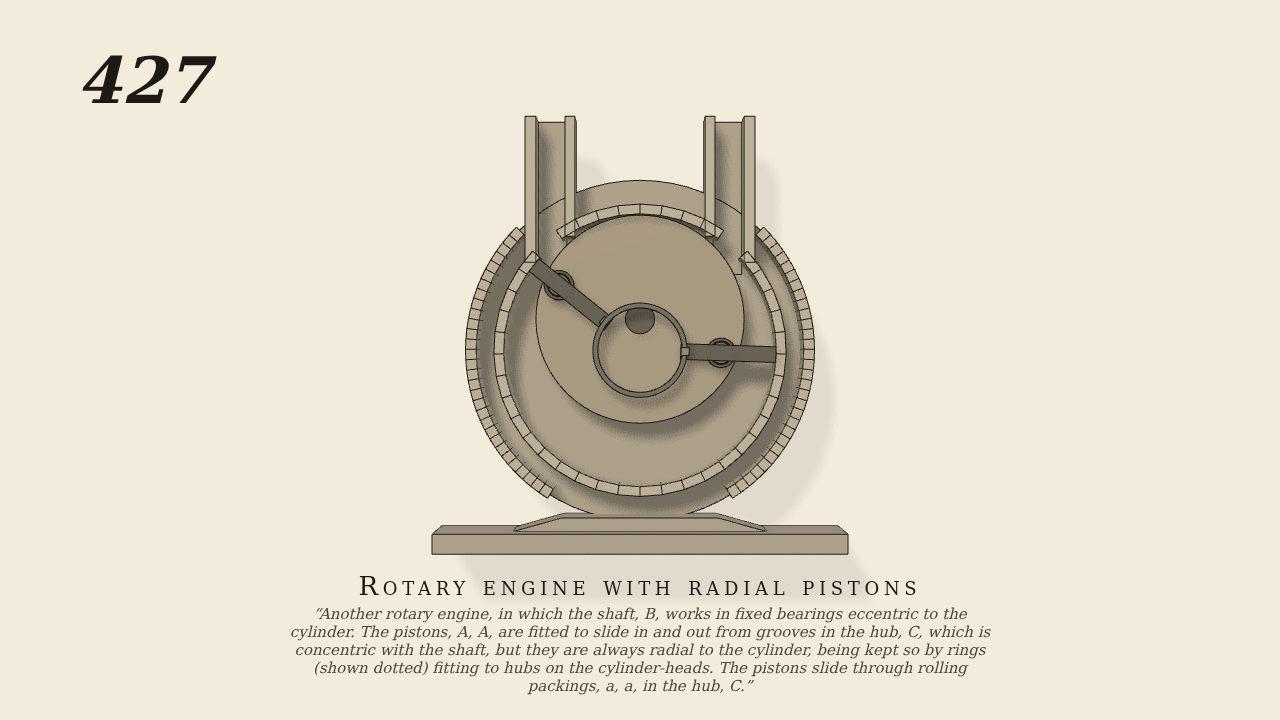
Another rotary engine, in which the shaft, B, works in fixed…
Another rotary engine, in which the shaft, B, works in fixed bearings eccentric to the cylinder. The pistons, A, A, are fitted to slide in and out from grooves in the hub, C, which is concentric with the shaft, but they are always radial to the cylinder, being kept so by rings (shown dotted) fitting to hubs on the cylinder-heads. The pistons slide through rolling packings, a, a, in the hub, C.
Only the input is driven; every other part of this model moves by physics (MuJoCo), and its ratios are measured. Run it live, change its parameters, or switch the friction off to see the output stop.
- Modelled as
- Brown's section through the cylinder, no gravity. The cylinder's bore is 14 cm across; the shaft B works in fixed bearings 1.6 cm above the cylinder's centre, and the hub C (10.72 cm across) is concentric with the shaft and just clears the bore at the top, between the induction and eduction ports. Each piston A is fast on its own ring turning about the cylinder's centre on the cylinder-head's hub (Brown's dotted rings), so it is always radial to the cylinder and its edge always just clears the bore; it slides through a rolling packing a that turns in the hub 4.5 cm from the shaft. The one driven input is the steam on the pistons (driver feet.ports): in at the right-hand port and out at the left, it pushes clockwise on whichever piston has live steam behind it and the exhaust ahead (the leading one of the two between the ports; when it reaches the exhaust port the other takes over), in proportion to the face it shows between hub and bore, as a torque about the cylinder's centre on its ring; the windows and faces follow from the packings' geometry and are timed by the shaft's own turn. The rings carry the hub round through the packings, the shaft free against a load (0.0391 N m s).
- Measured
- Started at rest in Brown's position, the shaft and hub run one way only (clockwise as drawn, with Brown's arrows) at about 6.1 rad/s (59 rev/min; 7.3 turns in 7.5 s; between 1.9 and 10.8 rad/s as the steam passes from one piston to the other), with no run-back, and the pistons on their rings go round with them, each at its own varying speed, always radial to the cylinder; each slides 3.2 cm (twice the eccentricity) in and out through its packing every turn. No part touches another but through the pins, so nothing penetrates. With the ports blocked the shaft stands.
- Notes
- The cylinder is cut through and only its back half is drawn, without hatching; the steam's pressure is modelled as a torque on the leading piston's ring in proportion to the face it shows (a harmonic fit, within 1.6% of the face), without expansion in the closed space between the pistons, not as gas in the working spaces; the packings are kept between the ends of their pistons; the rings are drawn in front of the hub (Brown dots them, behind) and the pistons are plain bars without his wedge-shaped inner ends; a pedestal and bed are drawn under the cylinder.
Film (MP4) · Still (PNG) · Spec (YAML) · Model (MJCF)