Another form of rotary engine, in which there are two stationary…
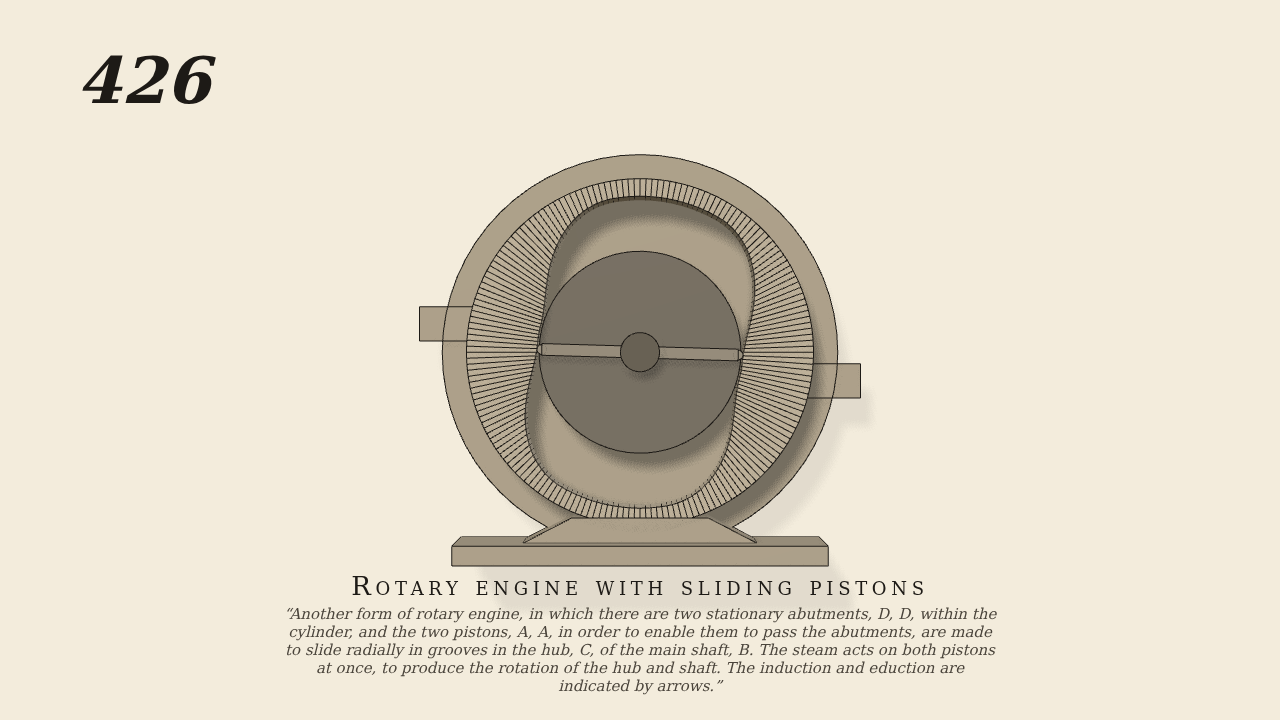
Another form of rotary engine, in which there are two stationary abutments, D, D, within the cylinder, and the two pistons, A, A, in order to enable them to pass the abutments, are made to slide radially in grooves in the hub, C, of the main shaft, B. The steam acts on both pistons at once, to produce the rotation of the hub and shaft. The induction and eduction are indicated by arrows.
Only the input is driven; every other part of this model moves by physics (MuJoCo), and its ratios are measured. Run it live, change its parameters, or switch the friction off to see the output stop.
- Modelled as
- Brown's section through the cylinder, gravity on. The hub C (10.4 cm across) is fast on the main shaft B at the cylinder's centre; the cylinder's bore is 16 cm across, and its two stationary abutments D, D (left a little high and right a little low, as Brown draws them) close in to just clear the hub, the bore easing in and out to them in smooth ramps. The two pistons A, A are plates sliding radially in one groove through the hub, each pressed outwards by a light spring in the groove and pushed in by the bore as it passes an abutment; the pistons' rounded edges against the bore are the only contacts. The steam acting on both pistons at once (the one driven input) is modelled as a steady torque on the shaft, which works against a load.
- Measured
- Started at rest in Brown's position (the pistons upright), the hub and shaft turn one way only (anticlockwise as drawn, with Brown's arrows) at about 5.5 rad/s (53 rev/min), never slower than about 4.3 rad/s; each piston slides 2.7 cm into its groove to pass each abutment and out again to the bore after it, twice a turn; no part penetrates another.
- Notes
- The cylinder is cut through and only its back half is drawn, without hatching, its wall drawn in narrow segments; the steam is modelled as a steady torque on the shaft rather than as pressure on the pistons, and the pistons are kept out against the bore by springs in the groove (Brown does not say what keeps them out); the ports are drawn as short stubs, and a pedestal and bed are drawn under the cylinder.
Film (MP4) · Still (PNG) · Spec (YAML) · Model (MJCF)