One of the many forms of rotary engine
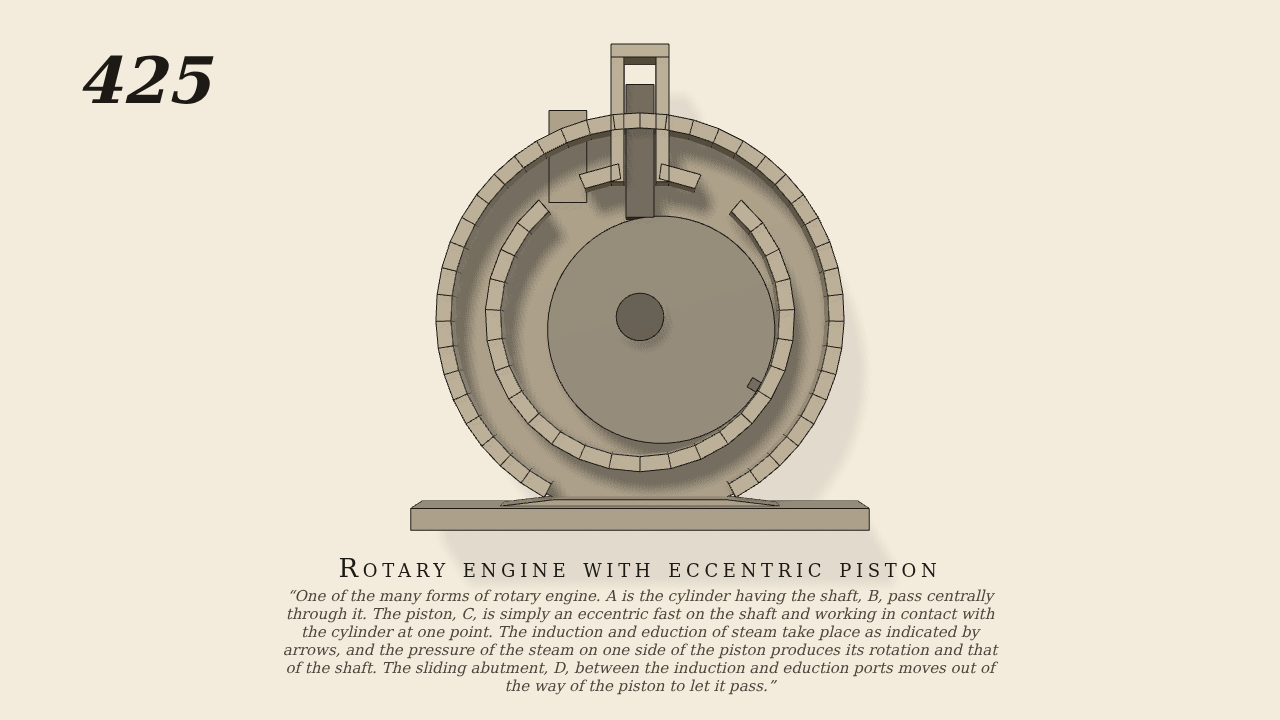
One of the many forms of rotary engine. A is the cylinder having the shaft, B, pass centrally through it. The piston, C, is simply an eccentric fast on the shaft and working in contact with the cylinder at one point. The induction and eduction of steam take place as indicated by arrows, and the pressure of the steam on one side of the piston produces its rotation and that of the shaft. The sliding abutment, D, between the induction and eduction ports moves out of the way of the piston to let it pass.
Only the input is driven; every other part of this model moves by physics (MuJoCo), and its ratios are measured. Run it live, change its parameters, or switch the friction off to see the output stop.
- Modelled as
- Brown's section through the cylinder, gravity on. The cylinder A (6.5 cm bore) has the shaft B through its centre; the piston C is an eccentric 10.62 cm across, set 1.15 cm off the shaft and fast on it, so it just meets the bore at one point all round. The sliding abutment D (1.3 cm wide) slides up and down in a guide at the top of the cylinder, between the induction port and the eduction port, and rests on the piston by its own weight; the piston against D is the only contact. The steam's pressure on the one side of the piston (the one driven input) is modelled as a steady torque on the shaft, which works against a load.
- Measured
- Started at rest in Brown's position (the piston's centre straight below B), the shaft turns one way only at about 5.1 rad/s (49 rev/min) with no run-back, and D is lifted by the piston's crown as it comes round and falls back on it after, rising and falling 2.3 cm (twice the eccentricity) every turn, so it moves out of the way of the piston to let it pass, as Brown says; no part penetrates another.
- Notes
- The cylinder is cut through and only its back half is drawn, without hatching; the steam is modelled as a steady torque on the shaft rather than as pressure in the space between C, the bore and D; D falls back on the piston by its own weight (Brown shows no spring); a pedestal and bed are drawn under the cylinder.
Film (MP4) · Still (PNG) · Spec (YAML) · Model (MJCF)