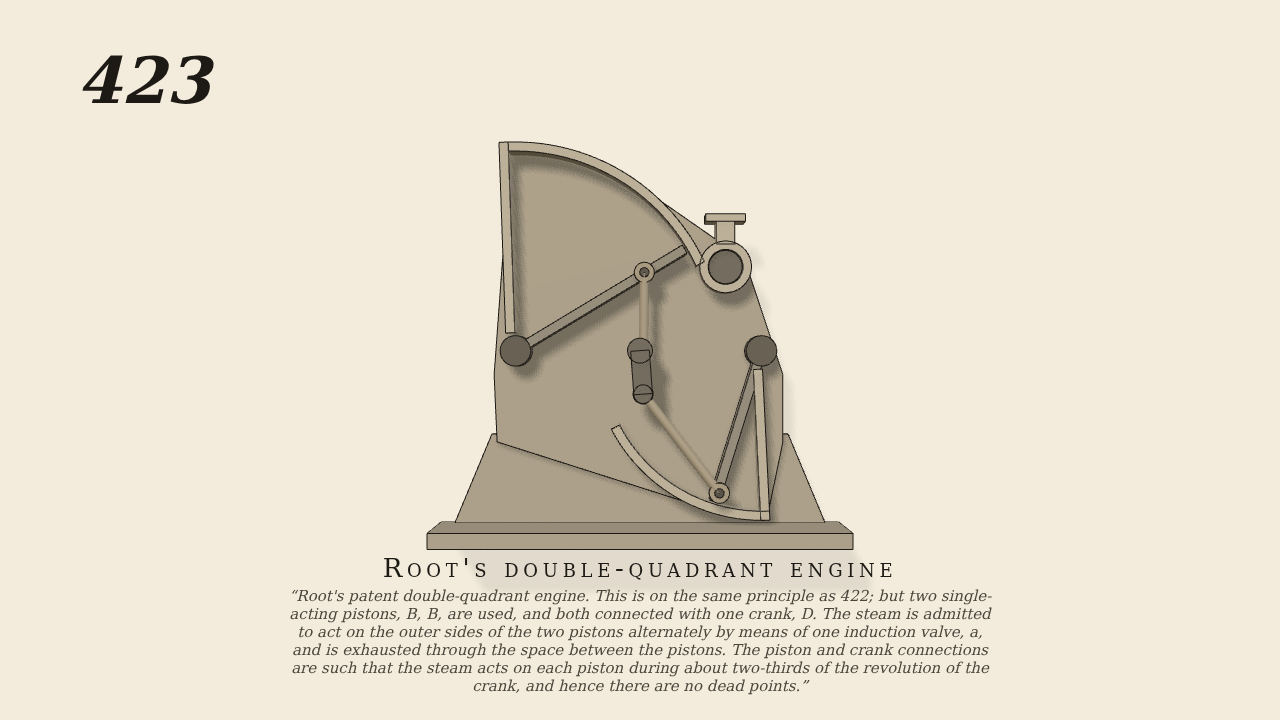
Root’s patent double-quadrant engine
Root’s patent double-quadrant engine. This is on the same principle as 422; but two single-acting pistons, B, B, are used, and both connected with one crank, D. The steam is admitted to act on the outer sides of the two pistons alternately by means of one induction valve, a, and is exhausted through the space between the pistons. The piston and crank connections are such that the steam acts on each piston during about two-thirds of the revolution of the crank, and hence there are no dead points.
Only the input is driven; every other part of this model moves by physics (MuJoCo), and its ratios are measured. Run it live, change its parameters, or switch the friction off to see the output stop.
- Modelled as
- Brown's section through the casing, no gravity. The two single-acting quadrant pistons B, B are vanes on pivots at the casing's left and right (16.2 cm apart), the left 13 cm long and the right 10.4 cm, each sweeping its own quadrant, closed on the outer side and open on the inner side to the exhaust space between them, where the crank-shaft D is. A rod from a pin on the inner face of each piston (7.9 cm from 9.9 cm out on the left, 8.1 cm from 9.65 cm out on the right) takes the one 2.8 cm crank-pin. The steam (the one driven input) presses on the outer side of each piston in turn, let in by the crank's own position as the induction valve a would let it in. The crank works against a load and carries a disc behind the casing (Brown's dotted circle); there is no fly-wheel.
- Measured
- Started at rest in Brown's position, the crank runs one way only (clockwise as drawn, no run-back) at about 5.9 rad/s (56 rev/min), never slower than about 4.4 rad/s in a turn, with no dead points: as the linkage is laid out, each piston can drive the crank through about 212 degrees of its turn (0.59 of a revolution, Brown's 'about two-thirds'), so the two pistons' working strokes overlap at both change-overs. The left piston rocks 20.4 degrees and the right 21.2 degrees either way, as the four-bar geometry gives; no part penetrates another.
- Notes
- The casing is cut through and only its back half is drawn, without hatching; the induction valve a is drawn fixed, its timing modelled by the crank's position, and each piston is given steam for half a turn, changing over within the overlaps, rather than for two-thirds of a turn; the crank has a disc behind the casing (reading Brown's dotted circle as one) and a pedestal is drawn under the casing.
Film (MP4) · Still (PNG) · Spec (YAML) · Model (MJCF)