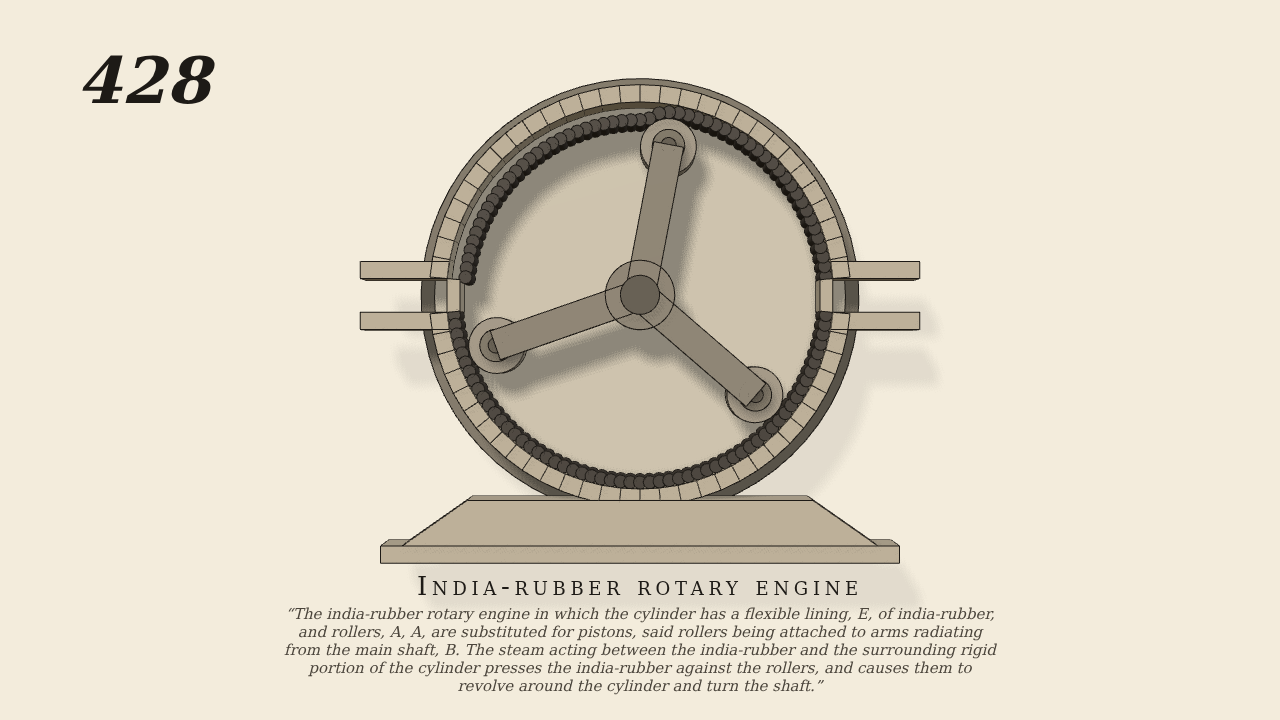
The india-rubber rotary engine in which the cylinder has a…
The india-rubber rotary engine in which the cylinder has a flexible lining, E, of india-rubber, and rollers, A, A, are substituted for pistons, said rollers being attached to arms radiating from the main shaft, B. The steam acting between the india-rubber and the surrounding rigid portion of the cylinder presses the india-rubber against the rollers, and causes them to revolve around the cylinder and turn the shaft.
Only the input is driven; every other part of this model moves by physics (MuJoCo), and its ratios are measured. Run it live, change its parameters, or switch the friction off to see the output stop.
- Modelled as
- Brown's section, gravity on. A rigid cylinder 18 cm across is lined with india-rubber E, which is clamped at the two ports: induction on the left, eduction on the right. The lining is a row of round strips, each free to be pressed in radially by up to 0.5 cm. The rubber's own stiffness (30 N/m) pulls each strip back against the casing. Three rollers A, each free on its pin, are carried on a three-armed spider fast on the main shaft B, and at rest they just clear the lining. A fly-wheel sits behind the cylinder. The steam is the one input. It gets between the casing and the lining on the upper side, from the induction port round to the roller that last passed, and pushes each strip there in with 1.5 N. The rubber therefore bulges in behind that roller and presses on its back. The roller pinches the lining against the casing, so it cuts the steam off from the eduction, and the steam behind it escapes when it reaches the eduction. This timing uses steam ports (feet.ports), one per strip, timed by the shaft's angle. The shaft is otherwise free, against a load of 0.02 N m s.
- Measured
- From rest the shaft turns clockwise as drawn (Brown's arrow) and settles at about 4.2 rad/s (40 rev/min), never running back. The lining is pressed in behind the leading roller and lies against the casing ahead of it. The rollers roll on the lining as they go round. Contact penetration stays within 1.3 mm.
- Notes
- The rubber is modelled as separate radial strips, each with its own spring, rather than a continuous sheet: they do not stretch along the bore or pull on one another. The steam pressure on each strip is a constant force, on while the strip lies between the induction and the leading roller. The bulge is shallower than Brown draws it. The starting pose is turned 15 degrees from Brown's, because with a roller at the induction port the engine stands at a dead point and does not start. The casing is a plain round shell with straight port passages, not Brown's swelled casing.
Film (MP4) · Still (PNG) · Spec (YAML) · Model (MJCF)