Root’s double-reciprocating or square piston engine
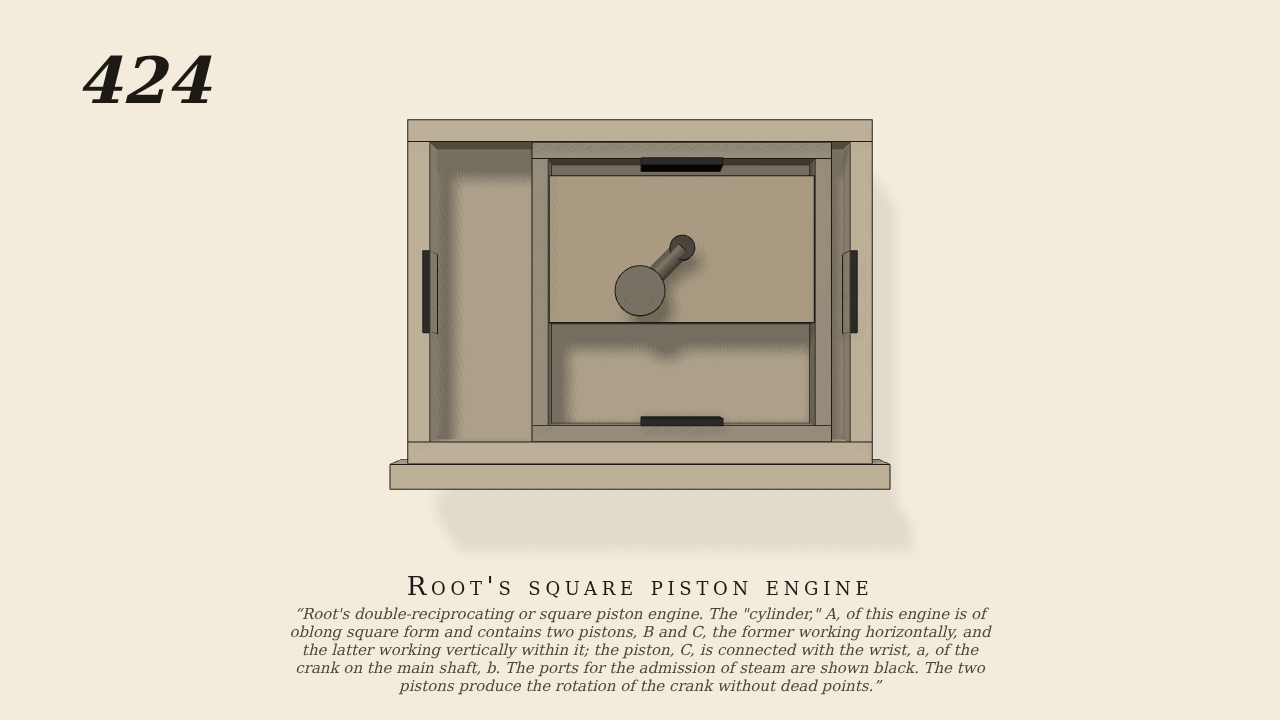
Root’s double-reciprocating or square piston engine. The “cylinder,” A, of this engine is of oblong square form and contains two pistons, B and C, the former working horizontally, and the latter working vertically within it; the piston, C, is connected with the wrist, a, of the crank on the main shaft, b. The ports for the admission of steam are shown black. The two pistons produce the rotation of the crank without dead points.
Only the input is driven; every other part of this model moves by physics (MuJoCo), and its ratios are measured. Run it live, change its parameters, or switch the friction off to see the output stop.
- Modelled as
- Brown's section, no gravity (the engine may lie any way). The cylinder A is an oblong box 15.4 x 11 cm inside. The piston B is an open square frame 11 cm across that slides across in A (4.4 cm stroke); the piston C (9.8 x 5.4 cm) slides up and down inside B (4.4 cm stroke) and is pinned at its middle to the wrist a of the crank, 2.2 cm from the main shaft b at the middle of A, so B follows the wrist across and C follows it up and down. The one driven input is the steam, let in by four ports shown black, at A's two ends (behind and in front of B) and in B's top and bottom (above and below C) (driver feet.ports): each is a 10 N push on its piston (C's reacting on B), open for the half turn in which it drives the crank forward, timed by the shaft's own turn; the shaft is free against a load (0.05 N m s). B's push turns the crank with F R abs(sin θ), C's with F R abs(cos θ), so one is at full lever when the other is at its dead point.
- Measured
- Started at rest in Brown's position (the wrist a down and to the right of b), the shaft runs one way only (anticlockwise as drawn) at about 5.6 rad/s (53 rev/min; 6.6 turns in 7.5 s), never slower than 4.5 rad/s, with no run-back and no fly-wheel: there are no dead points, as Brown says; B goes 2.2 cm either way across and C 2.2 cm up and down every turn. With only B's ports (or only C's) open it stops on its first dead point (B alone with the wrist at the right, C alone at the top); with the ports a quarter turn out it stands; half a turn out it runs backwards; blocked, it stands.
- Notes
- The cylinder is cut through and only its back is drawn, without hatching; the steam's pressure is modelled as a constant push on each piston for the half turn its port is open (no cut-off or expansion), not as gas in the spaces; the valve gear that opens the ports is not drawn (Brown does not show it); the crank is drawn in front of C (Brown dots it, behind); the parts are kept in line by their slides, not by contact; a bed is drawn under the cylinder.
Film (MP4) · Still (PNG) · Spec (YAML) · Model (MJCF)