Trunk engine used for marine purposes
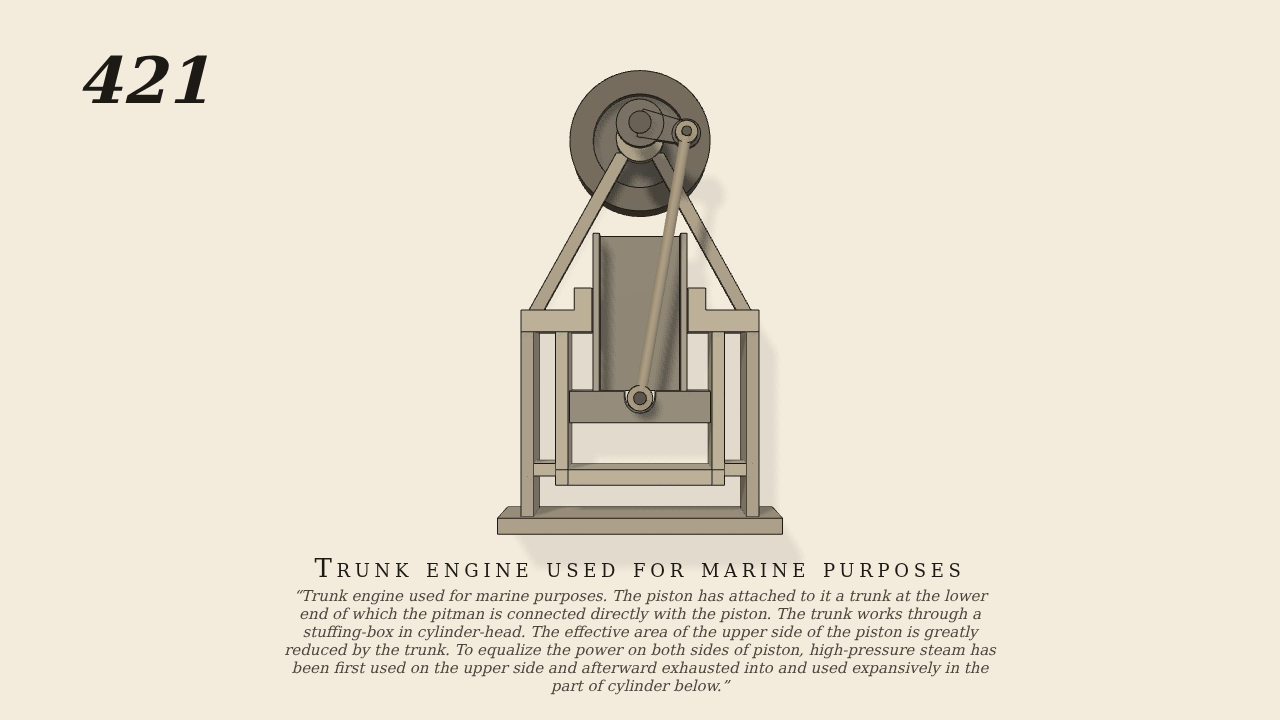
Trunk engine used for marine purposes. The piston has attached to it a trunk at the lower end of which the pitman is connected directly with the piston. The trunk works through a stuffing-box in cylinder-head. The effective area of the upper side of the piston is greatly reduced by the trunk. To equalize the power on both sides of piston, high-pressure steam has been first used on the upper side and afterward exhausted into and used expansively in the part of cylinder below.
Only the input is driven; every other part of this model moves by physics (MuJoCo), and its ratios are measured. Run it live, change its parameters, or switch the friction off to see the output stop.
- Modelled as
- Brown's section through the cylinder, no gravity. The piston carries a trunk, a tube 6 cm across that passes out through the stuffing-box in the cylinder-head; the pitman (17 cm) is pinned on the gudgeon in a hollow of the piston, inside the trunk, and takes the 3 cm crank of the shaft above, swinging within the trunk. The steam (the one driven input) presses the piston down on the down-stroke and up on the up-stroke with the same force, let in by the shaft's own position (greatest at half-stroke, nothing at the dead-centres). The shaft works against a load and carries a fly-wheel behind its standard.
- Measured
- Started at rest at half-stroke, the shaft runs one way only (clockwise as drawn, no run-back), over both dead-centres every turn, at about 6.3 rad/s (60 rev/min). The piston's stroke is twice the crank (amplitude 3.0 cm) and the pitman swings about 10 degrees either way inside the trunk, as asin(3/17) gives; no part penetrates another.
- Notes
- The cylinder, piston and trunk are cut through and only their back half is drawn, without hatching; a fly-wheel (not in the figure, whose dotted circle is the crank's path) is put on the shaft behind the standard to carry the crank over the dead-centres; the shaft's standard is drawn behind the cylinder; the steam is the same force on both sides of the piston: the equal power Brown describes is modelled, not his high-pressure steam on top exhausted to work expansively below.
Film (MP4) · Still (PNG) · Spec (YAML) · Model (MJCF)