Arrangement of hammer for striking bells
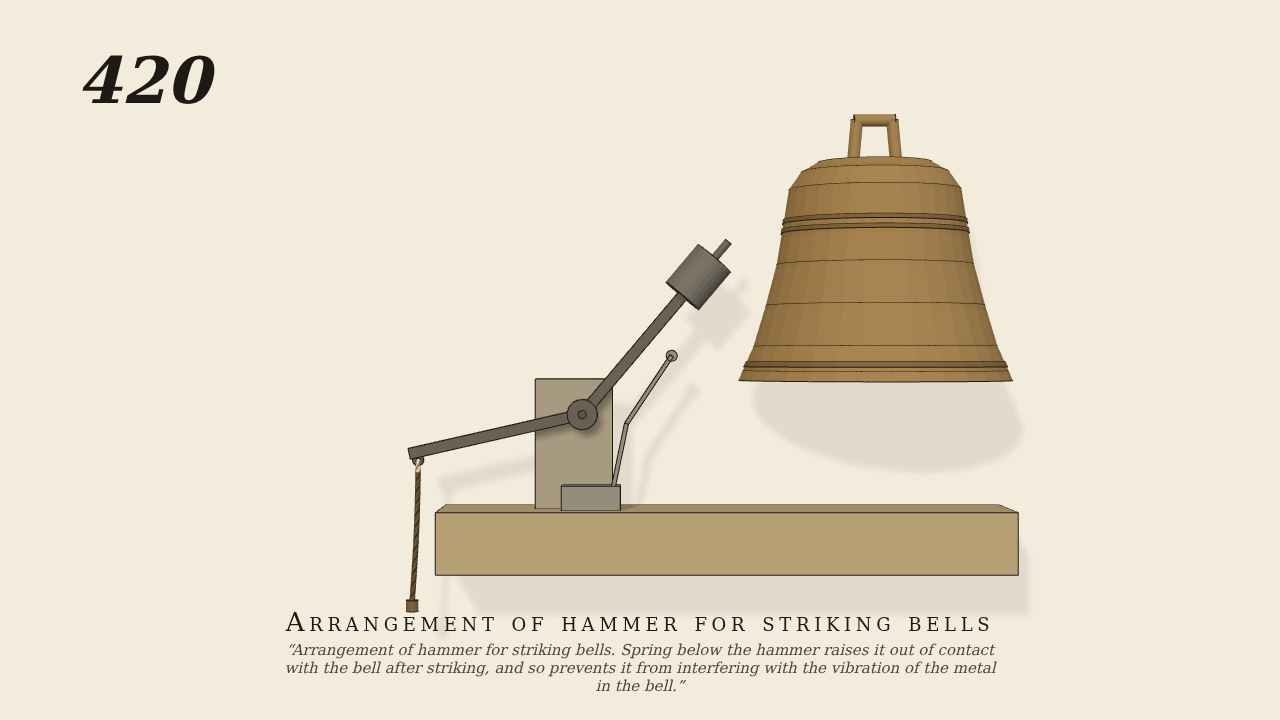
Arrangement of hammer for striking bells. Spring below the hammer raises it out of contact with the bell after striking, and so prevents it from interfering with the vibration of the metal in the bell.
Only the input is driven; every other part of this model moves by physics (MuJoCo), and its ratios are measured. Run it live, change its parameters, or switch the friction off to see the output stop.
- Modelled as
- Brown's side view, gravity on. The hammer is on a lever pivoted in a stand on the plank; from the end of its other arm, level to the left, hangs the bell-pull cord, and the hand on the cord (the one driven joint) draws it down and lets it go, once every 2 s. A flat spring set in the stand bears up under the hammer arm. Drawn down, the cord lifts the hammer back from the bell; let go, the hammer falls by its own weight, strikes the bell, and the spring, pressed down by the blow, throws it back off.
- Measured
- Every blow reaches the bell (the hammer is stopped by it at -0.040 rad from its rest) and never passes it; after each blow the spring lifts the hammer clear and it lies at about -0.007 rad, some 4 mm off the bell, until the next pull; no part penetrates another.
- Notes
- The bell is fixed (it does not ring or swing); the spring is a hinged leaf with a torsion stiffness rather than a bent flat spring; the hand is a weight on the cord pulled by a press-only force; the poster shows the hammer drawn back.
Film (MP4) · Still (PNG) · Spec (YAML) · Model (MJCF)