Continuous circular motion converted into a rocking motion
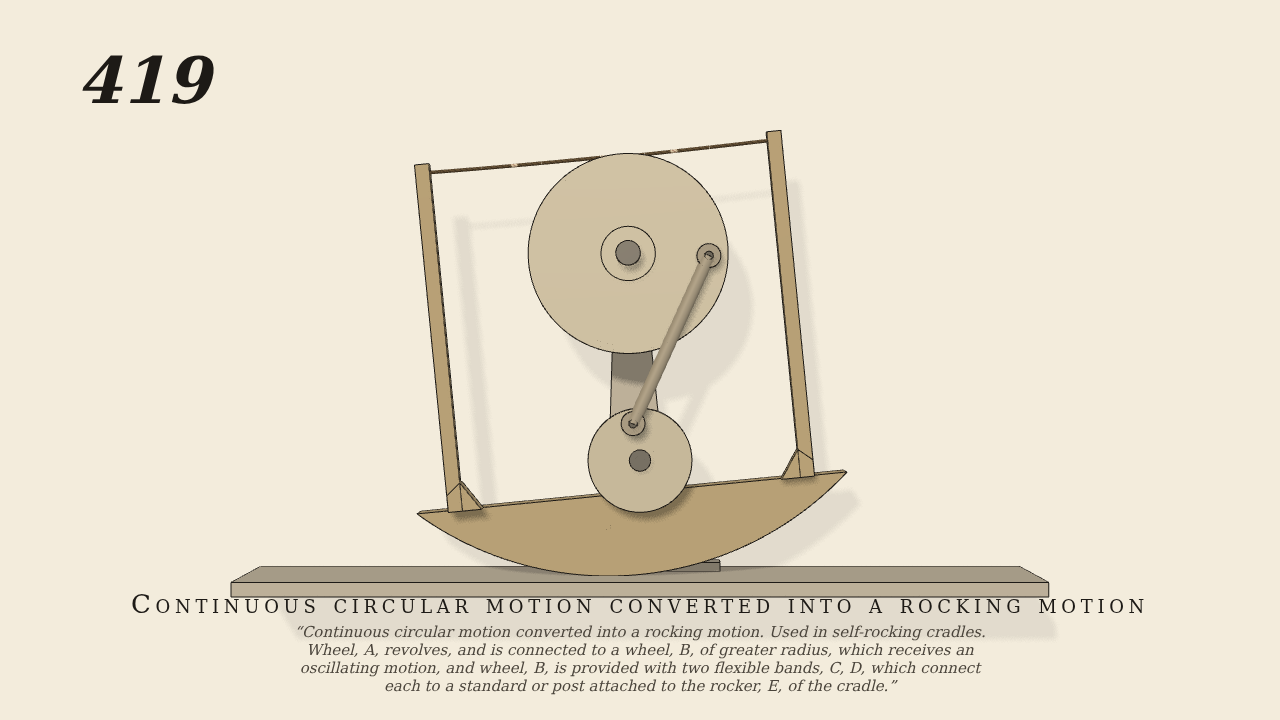
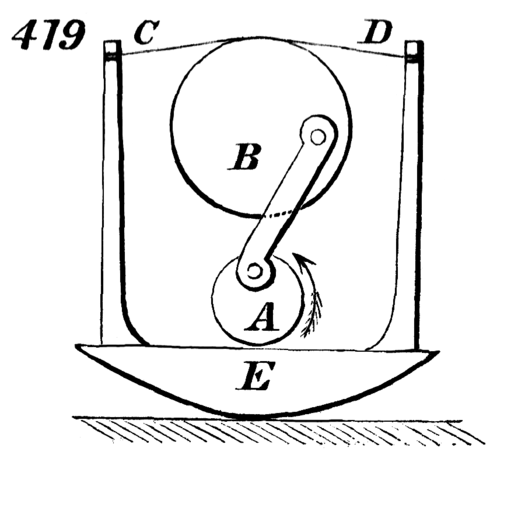
Continuous circular motion converted into a rocking motion. Used in self-rocking cradles. Wheel, A, revolves, and is connected to a wheel, B, of greater radius, which receives an oscillating motion, and wheel, B, is provided with two flexible bands, C, D, which connect each to a standard or post attached to the rocker, E, of the cradle.
Only the input is driven; every other part of this model moves by physics (MuJoCo), and its ratios are measured. Run it live, change its parameters, or switch the friction off to see the output stop.
- Modelled as
- Brown's front view, gravity on. The wheel A (the one driven joint, turned steadily) carries a crank pin and rod that swing the larger wheel B back and forth, through about 57 degrees in all. Two flexible bands, C and D, wound on B in opposite senses, are fastened to the posts of the rocker E, a circular-bottomed cradle rolling on the floor. As B swings, one band winds and the other unwinds, drawing the posts alternately and rocking the cradle.
- Measured
- The cradle rocks steadily, about +/-0.11 rad (6.5 degrees) each way, in step with B (follow ratio 0.232, within 0.02), and rolls on the floor without slipping (its slide follows the roll within 1%); no part penetrates another.
- Notes
- The crank's pose differs from the figure (Brown draws B's pin at the upper right; here it is at its middle position below right); A and B are carried on a standard behind the cradle; the cradle body is not drawn, only its rocker and posts; the bands are kept taut by a small pretension rather than drawn with their sag.
Film (MP4) · Still (PNG) · Spec (YAML) · Model (MJCF)