Continuous circular motion into a rectilinear reciprocating
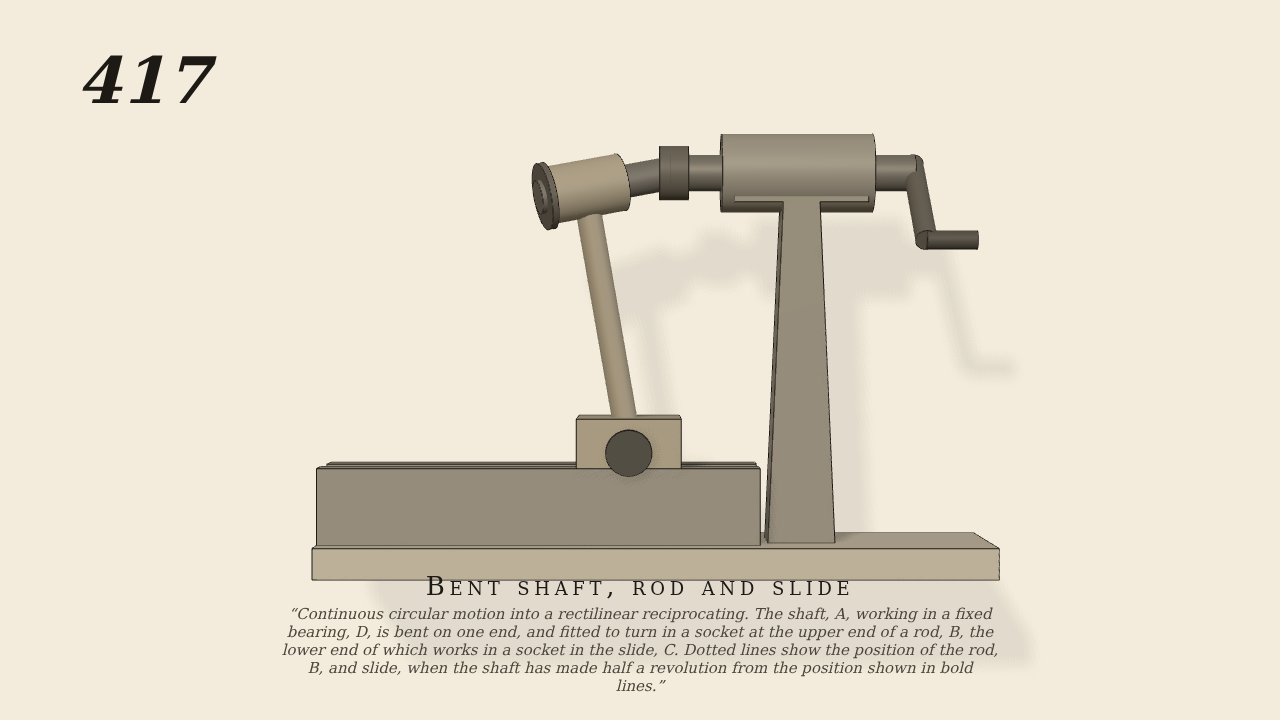
Continuous circular motion into a rectilinear reciprocating. The shaft, A, working in a fixed bearing, D, is bent on one end, and fitted to turn in a socket at the upper end of a rod, B, the lower end of which works in a socket in the slide, C. Dotted lines show the position of the rod, B, and slide, when the shaft has made half a revolution from the position shown in bold lines.
Only the input is driven; every other part of this model moves by physics (MuJoCo), and its ratios are measured. Run it live, change its parameters, or switch the friction off to see the output stop.
- Modelled as
- Brown's side elevation, gravity off, built as the 3-D linkage it is. The shaft A turns in the fixed bearing D (the one driven joint, by its crank at 20 rpm); its end is bent down 20 degrees. The socket at the head of the rod B turns on the bent end (two pins on its axis make the turning pair). The rod's lower end passes through a ball socket in the slide C: the ball swivels every way in the slide (three hinges) and the rod slides through it, and C runs in its guide. As the bent end goes round, the rod's head goes round a circle and the rod, square to the bent end, rocks from leaning one way to leaning the other.
- Measured
- C goes 6.55 cm to and fro (2 tan 20 deg x the shaft's height above the socket), one stroke each way per turn of A, sustained over the run; the rod's head stays on the bent end throughout.
- Notes
- The ball socket is made of three hinges and the rod slides through the ball (Brown's dotted rod reaches further below the shaft than the bold one, so its length between the bend and C must change); C runs in a plain guide and the hatched section of the guide is not drawn; gravity is off.
Film (MP4) · Still (PNG) · Spec (YAML) · Model (MJCF)