A device for assisting the crank of a treadle motion over the…
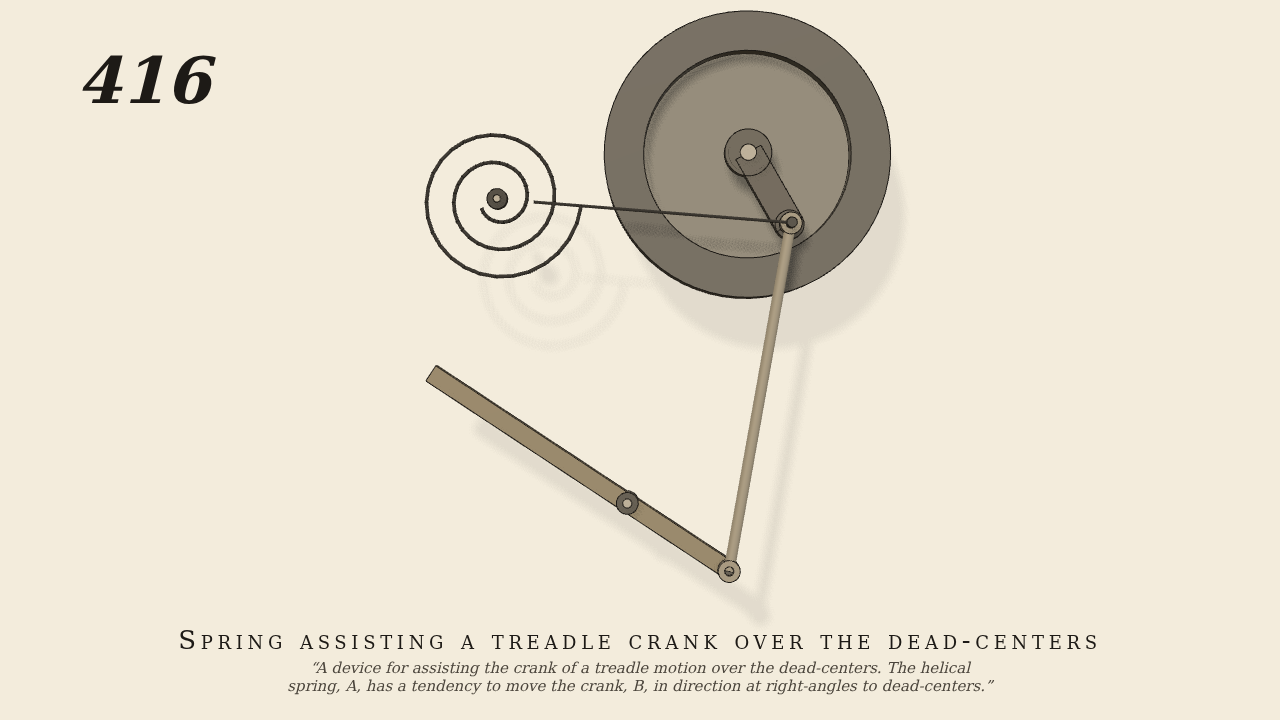
A device for assisting the crank of a treadle motion over the dead-centers. The helical spring, A, has a tendency to move the crank, B, in direction at right-angles to dead-centers.
Only the input is driven; every other part of this model moves by physics (MuJoCo), and its ratios are measured. Run it live, change its parameters, or switch the friction off to see the output stop.
- Modelled as
- Brown's front view, gravity off. The fly-wheel carries the crank B; the connecting-rod takes it down to the treadle, a lever on a stud with the rod at its short end and the foot at its long one. The spring A is coiled on a stud to the left and its wire runs to the crank-pin: the wire is drawn out of the coil against the spring (20 N/m, a slide joint), so it always draws B towards A, at right angles to the dead-centers. The foot (the one input, press-only) presses the treadle's long end down through the half-turn that lifts the rod, timed by the wheel's own position, and lets it rise for the other half. The wheel starts at rest exactly on its lower dead-center, where the foot alone could not start it: the spring draws B off the centre and the foot takes it round.
- Measured
- From rest on the dead-center the wheel turns one way only (clockwise as drawn, never back more than 0.05 rad) and keeps turning over both dead-centers every turn at about 4 rad/s; no contacts are needed.
- Notes
- The spring's stretch is shown as the wire sliding out of the coil, and the coil swings on its stud as B goes round (Brown's spring is drawn fixed); the stud A sits a little further left than in the figure to leave room for the larger coil; the foot is a timed press-only torque on the treadle.
Film (MP4) · Still (PNG) · Spec (YAML) · Model (MJCF)