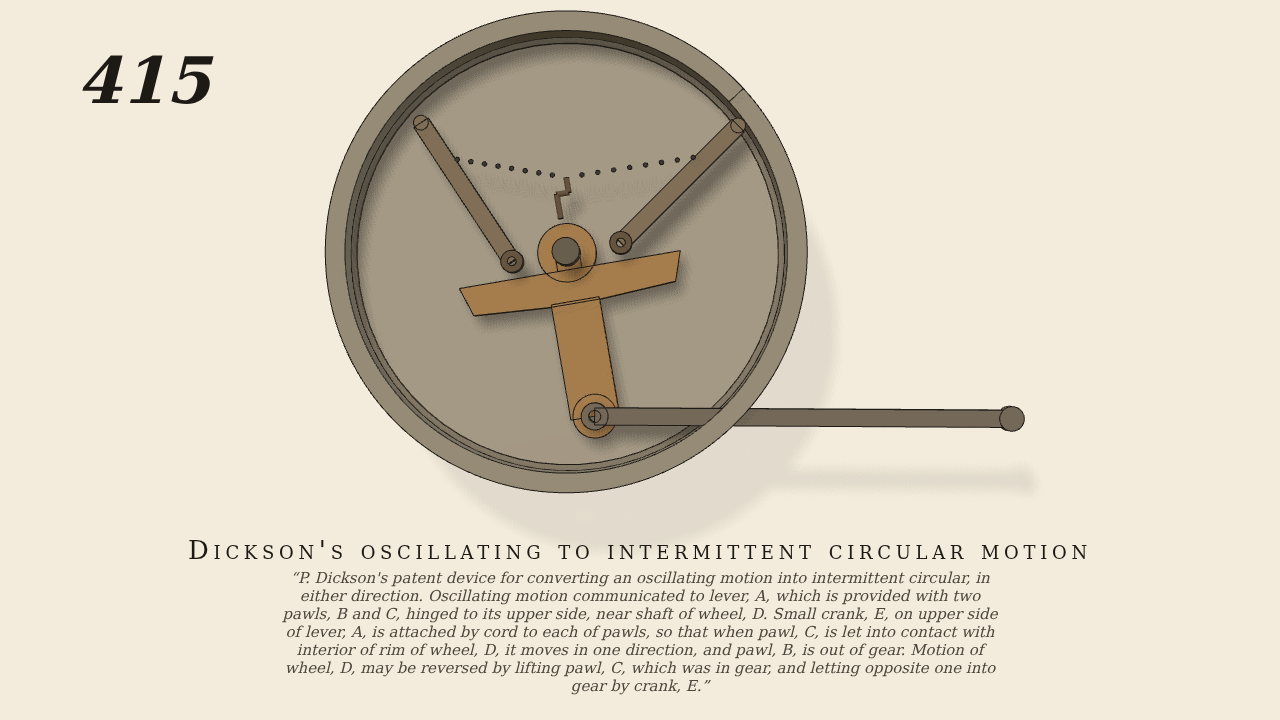
P. Dickson’s patent device for converting an oscillating motion…
P. Dickson’s patent device for converting an oscillating motion into intermittent circular, in either direction. Oscillating motion communicated to lever, A, which is provided with two pawls, B and C, hinged to its upper side, near shaft of wheel, D. Small crank, E, on upper side of lever, A, is attached by cord to each of pawls, so that when pawl, C, is let into contact with interior of rim of wheel, D, it moves in one direction, and pawl, B, is out of gear. Motion of wheel, D, may be reversed by lifting pawl, C, which was in gear, and letting opposite one into gear by crank, E.
Only the input is driven; every other part of this model moves by physics (MuJoCo), and its ratios are measured. Run it live, change its parameters, or switch the friction off to see the output stop.
- Modelled as
- Brown's plan, gravity off. The lever A turns loose on the wheel D's shaft and is rocked through about 34 degrees by the rod pinned to its foot (the one driven joint: the hand's stroke along the rod). The pawls B and C are hinged on A's upper side either side of the shaft and reach out to the plain inside of D's rim; a light spring lays the one in gear against the rim. It grips by friction alone: rocked one way it jams between its pin and the rim and carries D round; rocked back it trails and slides, and D stands. Halfway through, the crank E lifts C and lets B into gear (the cords' springs are reset), and D goes the other way.
- Measured
- Over the first half D steps forward about 0.25 rad a stroke and never runs back more than 0.03 rad; after the change over by E it steps the other way just as steadily; the deepest contact is within 2 mm tolerance.
- Notes
- The cords from E are drawn as dotted lines and do not move, and E is not seen to turn: the change over is made by resetting the pawls' spring settings at the halfway time; the pawls are plain bars with rounded noses.
Film (MP4) · Still (PNG) · Spec (YAML) · Model (MJCF)