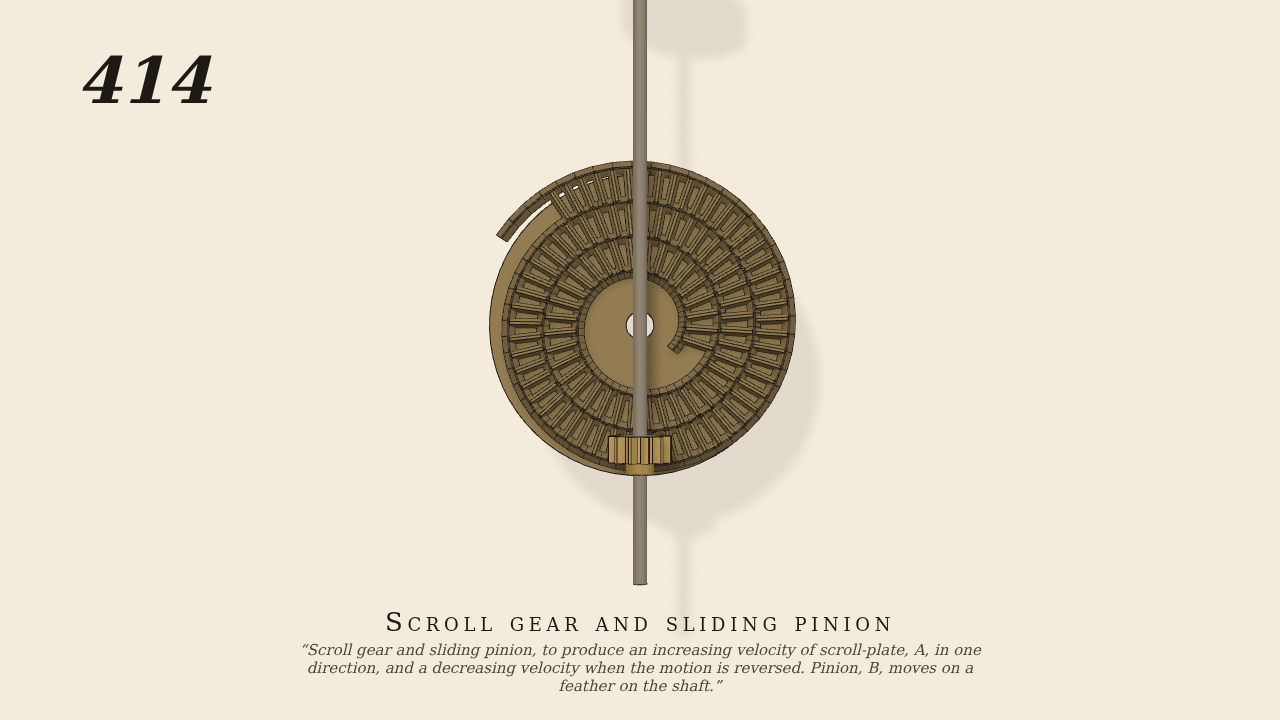
Scroll gear and sliding pinion, to produce an increasing velocity…
Scroll gear and sliding pinion, to produce an increasing velocity of scroll-plate, A, in one direction, and a decreasing velocity when the motion is reversed. Pinion, B, moves on a feather on the shaft.
Only the input is driven; every other part of this model moves by physics (MuJoCo), and its ratios are measured. Run it live, change its parameters, or switch the friction off to see the output stop.
- Modelled as
- Brown's plan, gravity off. The plate A turns on its centre and carries on its face a scroll of teeth, 2.4 turns, its radius growing 1.5 cm a turn, with a low bevelled ridge between the turns. The shaft runs across the plate's face through its centre and is turned to and fro (the one driven joint, a slow swing); the pinion B slides freely along it on a feather (a slide joint) and meshes with the scroll's teeth by real contact. The neighbouring turns push B along the shaft as A turns, so B follows the scroll in or out: A turns fast while B is near the centre and slow while it is near the rim.
- Measured
- B's slide follows A's turning at 1.5 cm a turn (0.0023873 m/rad measured 0.00238, r² 0.9999) through both directions of the swing, so A's speed for a given shaft speed rises as B moves in and falls as it moves out; the deepest contact is 0.36 mm.
- Notes
- The shaft's pulley sits out of frame above (it gives the shaft its inertia); a low bevelled ridge runs between the scroll's turns to keep B in the groove (Brown draws the teeth alone); the teeth are straight trapezoid bars, not involute.
Film (MP4) · Still (PNG) · Spec (YAML) · Model (MJCF)