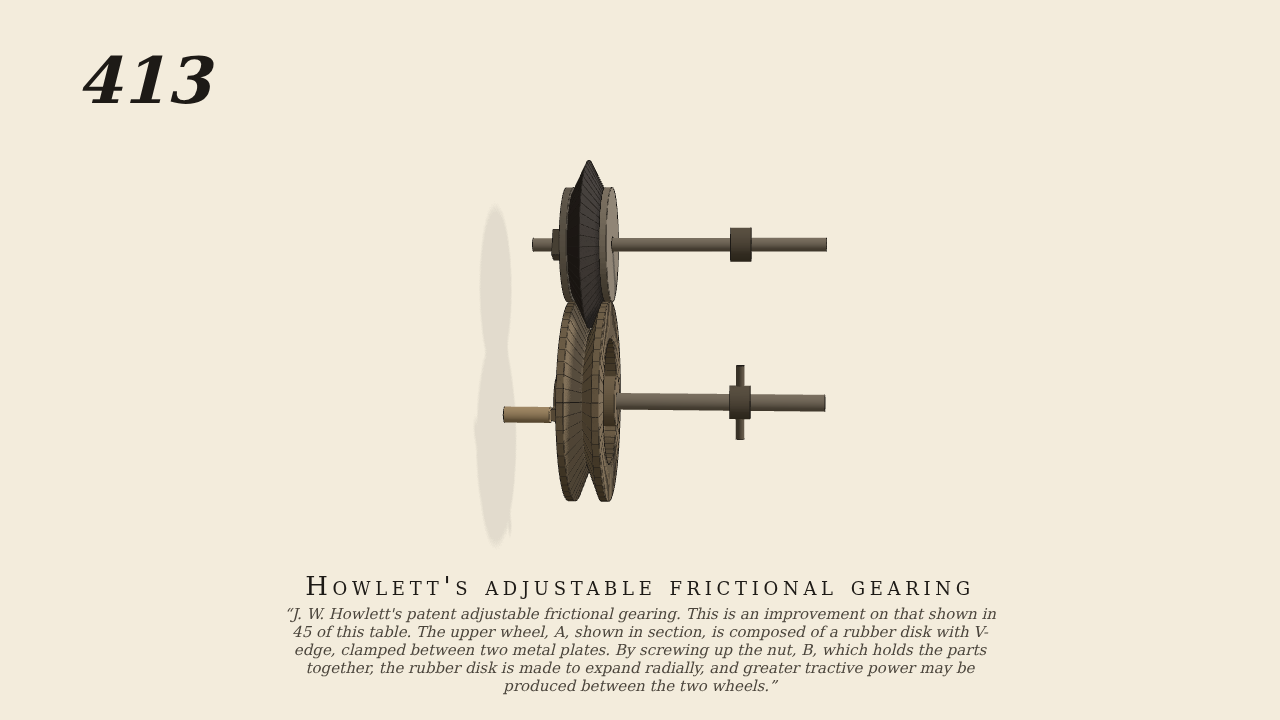
J. W. Howlett’s patent adjustable frictional gearing
J. W. Howlett’s patent adjustable frictional gearing. This is an improvement on that shown in 45 of this table. The upper wheel, A, shown in section, is composed of a rubber disk with V-edge, clamped between two metal plates. By screwing up the nut, B, which holds the parts together, the rubber disk is made to expand radially, and greater tractive power may be produced between the two wheels.
Only the input is driven; every other part of this model moves by physics (MuJoCo), and its ratios are measured. Run it live, change its parameters, or switch the friction off to see the output stop.
- Modelled as
- Brown's edge-on view, gravity on, the shafts running off to the right. The lower wheel, turned by its handle (the one driven joint, 30 rpm), has a V-groove in its rim. The upper wheel A is a rubber disk with a V-edge (black) clamped between two metal plates by the nut B on its shaft; A's bearings ride in a slide and are pressed down by a spring, so the V-edge bears on the groove's two lips and A is turned by friction alone (real contact, no coupling). The lips (radius 6 cm) roll on A's flanks at radius 3.4 cm, so A runs 1.765 times as fast, the other way.
- Measured
- A turns -1.765 times as fast as the lower wheel (r² 1.0; 6/3.4 = 1.7647, tol 0.02); the deepest contact is 0.017 mm.
- Notes
- The rubber's radial expansion by screwing up the nut B is not modelled: A is shown with the nut screwed up and its V-edge at full size; A is not drawn in section; the bearings and the pressing spring are plain.
Film (MP4) · Still (PNG) · Spec (YAML) · Model (MJCF)