Wheel-work in the base of capstan
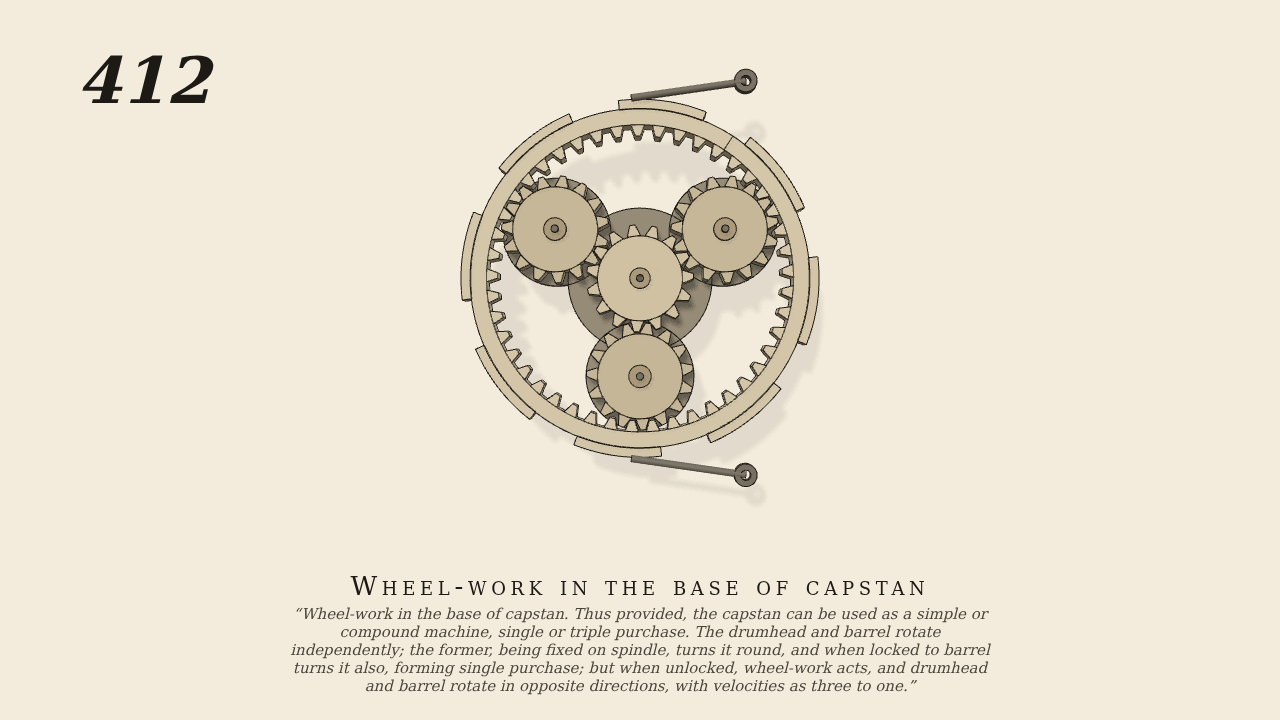
Wheel-work in the base of capstan. Thus provided, the capstan can be used as a simple or compound machine, single or triple purchase. The drumhead and barrel rotate independently; the former, being fixed on spindle, turns it round, and when locked to barrel turns it also, forming single purchase; but when unlocked, wheel-work acts, and drumhead and barrel rotate in opposite directions, with velocities as three to one.
Only the input is driven; every other part of this model moves by physics (MuJoCo), and its ratios are measured. Run it live, change its parameters, or switch the friction off to see the output stop.
- Modelled as
- Brown's plan, gravity off: the drumhead's spindle carries a 15-toothed wheel (the one driven joint, 12 rpm). Three 15-toothed idlers turn on studs fixed in the capstan's deck (the three-lobed plate behind them) and mesh both with the spindle's wheel and with a 45-toothed internal ring in the foot of the barrel, which turns on the spindle against a little friction. All the teeth mesh by real contact. With the drumhead unlocked from the barrel this is Brown's double purchase: the barrel turns the opposite way at a third of the drumhead's speed. His two pawls stand on the deck at top and bottom by the notched rim of the barrel.
- Measured
- The barrel turns -0.3333 times as fast as the drumhead (r² 0.99997, expect -1/3 ± 0.004) and each idler -0.9999 times (expect -1 ± 0.01); the deepest tooth contact is 0.02 mm.
- Notes
- Only the double purchase is modelled: the lock that makes drumhead and barrel turn together as a single purchase is not; the pawls are drawn but not engaged with the rim; the teeth are straight-flanked; the drumhead itself is not drawn in the plan.
Film (MP4) · Still (PNG) · Spec (YAML) · Model (MJCF)