Self-recording level for surveyors
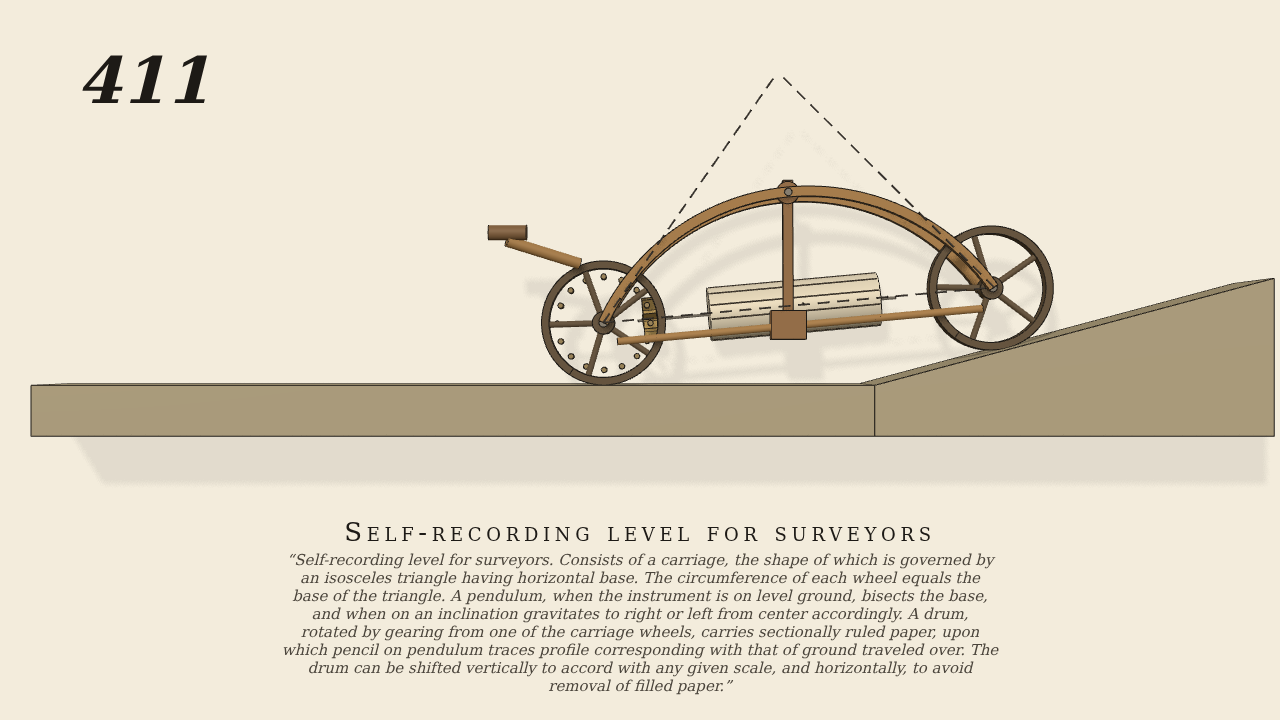
Self-recording level for surveyors. Consists of a carriage, the shape of which is governed by an isosceles triangle having horizontal base. The circumference of each wheel equals the base of the triangle. A pendulum, when the instrument is on level ground, bisects the base, and when on an inclination gravitates to right or left from center accordingly. A drum, rotated by gearing from one of the carriage wheels, carries sectionally ruled paper, upon which pencil on pendulum traces profile corresponding with that of ground traveled over. The drum can be shifted vertically to accord with any given scale, and horizontally, to avoid removal of filled paper.
Only the input is driven; every other part of this model moves by physics (MuJoCo), and its ratios are measured. Run it live, change its parameters, or switch the friction off to see the output stop.
- Modelled as
- Brown's side view, gravity on: the carriage stands on two wheels of radius 5 cm whose axles are 31.4 cm apart, so the base of Brown's isosceles triangle (drawn dotted) equals a wheel's circumference. The surveyor's hands push it to and fro along the ground, 18 cm either way at 0.05 Hz (the one driven joint, a slide along the level); the carriage is otherwise free to rise and tilt, so it rides on its wheels over the ground: level, then a 15 deg rise. The wheels roll by friction. Sixteen pegs standing out from the hind wheel's face turn an eight-leaved pinion on the drum's shaft by real contact, so the drum, ruled in sections, turns twice for each turn of the wheel. The pendulum hangs free from its pivot at the top of the frame; on the level it bisects the base, and on the rise it keeps upright, so against the carriage it swings out as far as the carriage tilts, its pencil against the drum.
- Measured
- The pendulum swings against the carriage by -0.98 of the carriage's tilt (r² 0.995, expect -1 ± 0.06; the small shortfall is the pendulum's lag behind the moving carriage). The hind wheel rolls without slipping, 20.19 rad per m (100/R = 20; the hind axle draws forward a little as the carriage tilts), and the drum turns 2.00 times for each turn of the wheel (r² 0.9996).
- Notes
- The pencil's trace is not drawn on the drum; the drum's vertical and sideways shifting is not modelled; the gearing is a ring of pegs and a leaved pinion rather than Brown's toothed wheels; the frame is a plain arch and the handle a plain bar.
Film (MP4) · Still (PNG) · Spec (YAML) · Model (MJCF)