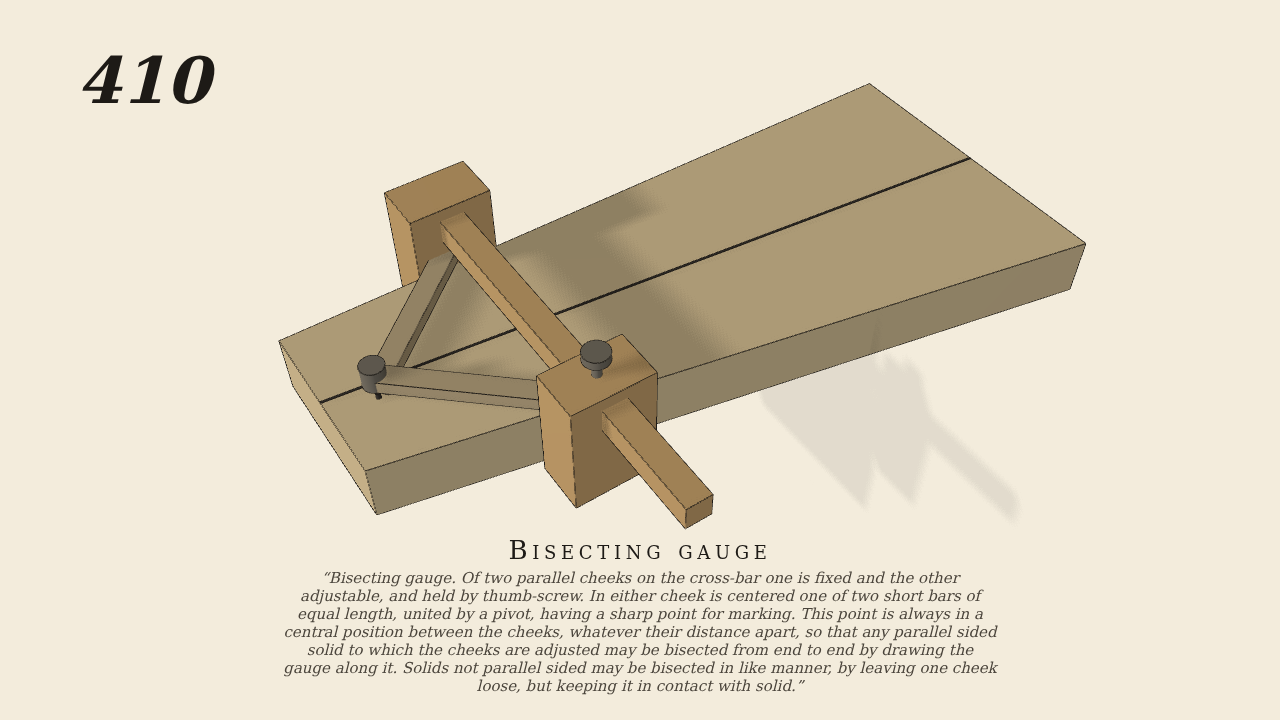
Bisecting gauge
Bisecting gauge. Of two parallel cheeks on the cross-bar one is fixed and the other adjustable, and held by thumb-screw. In either cheek is centered one of two short bars of equal length, united by a pivot, having a sharp point for marking. This point is always in a central position between the cheeks, whatever their distance apart, so that any parallel sided solid to which the cheeks are adjusted may be bisected from end to end by drawing the gauge along it. Solids not parallel sided may be bisected in like manner, by leaving one cheek loose, but keeping it in contact with solid.
Only the input is driven; every other part of this model moves by physics (MuJoCo), and its ratios are measured. Run it live, change its parameters, or switch the friction off to see the output stop.
- Modelled as
- Brown's oblique view, used as in his last sentence: the solid is not parallel sided (12 cm wide at the middle, widening 2 mm per cm), so the loose cheek is left free on the cross-bar and a light spring (the hand) keeps it against the solid's side. The fixed cheek bears on the straight side. The two short bars of equal length (9 cm) are centred one in each cheek and united by a pivot carrying the marking point. The hand slides the gauge along the solid, 8 cm either way (the one driven joint); the loose cheek follows the tapering side by real contact, and the point keeps to the middle. The middle line is drawn on the solid. Light readouts at the point record its place across the solid and carry nothing.
- Measured
- As the gauge is slid along, the loose cheek moves out and in 0.200 cm per cm of travel (the taper; r² 1.0000) and the marking point moves across exactly half as far: slope 0.5000 against the cheek (r² 1.0000, tol 0.01), so it stays on the middle line. Penetration at the solid's side stays under 0.01 mm.
- Notes
- The solid is drawn with plain ends (Brown breaks it off), the cheeks are plain blocks without his rounded tops, and the thumb-screw is drawn but slack (the cheek is loose, as Brown directs for a solid not parallel sided).
Film (MP4) · Still (PNG) · Spec (YAML) · Model (MJCF)