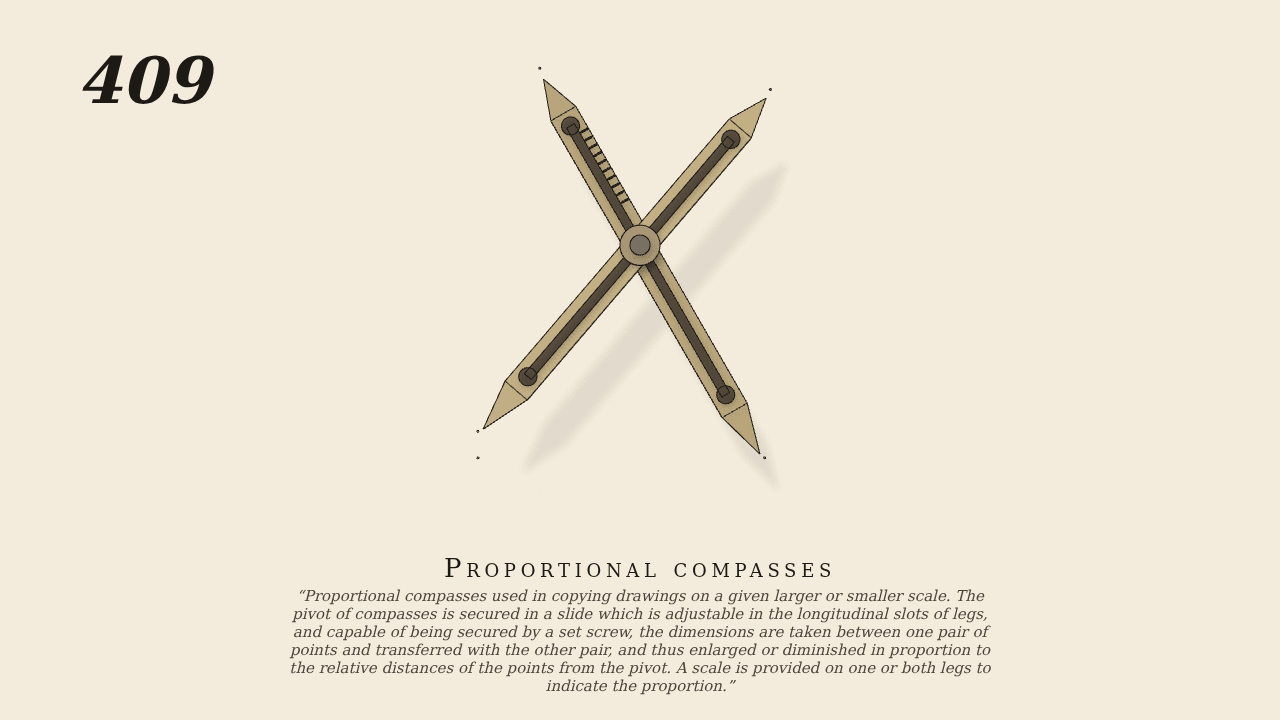
Proportional compasses used in copying drawings on a given larger…
Proportional compasses used in copying drawings on a given larger or smaller scale. The pivot of compasses is secured in a slide which is adjustable in the longitudinal slots of legs, and capable of being secured by a set screw, the dimensions are taken between one pair of points and transferred with the other pair, and thus enlarged or diminished in proportion to the relative distances of the points from the pivot. A scale is provided on one or both legs to indicate the proportion.
Only the input is driven; every other part of this model moves by physics (MuJoCo), and its ratios are measured. Run it live, change its parameters, or switch the friction off to see the output stop.
- Modelled as
- Brown's view, the compasses lying flat (no gravity): two equal legs, each pointed at both ends, crossed and joined by a pivot whose position along the legs' slots divides each leg 13.3 : 10.7 (the slide is set and clamped, so the pivot is a plain hinge here). One leg lies still on the drawing; the hand holds the other leg's long point and moves it across (the one driven joint, the hand following the point up and down as it goes round), so that leg turns on the pivot and the compasses open and close. Two light readouts, each pivoted at one point of the still leg and pinned at the other leg's matching point, record the gap between the long points and the gap between the short points and carry nothing.
- Measured
- As the long points open and close the short points open and close with them in the set proportion: the short gap follows the long gap with slope 0.8045 (r² 1.0000, expected 10.7/13.3 = 0.8045, tol 0.01).
- Notes
- The points are plain, without Brown's serrated grips; the scale on the legs is drawn but the slide and screw are shown clamped (the proportion is not altered during the clip); one leg is held still on the drawing so that only the hand drives.
Film (MP4) · Still (PNG) · Spec (YAML) · Model (MJCF)