Four-motion feed (A. B. Wilson’s patent), used on Wheeler &…
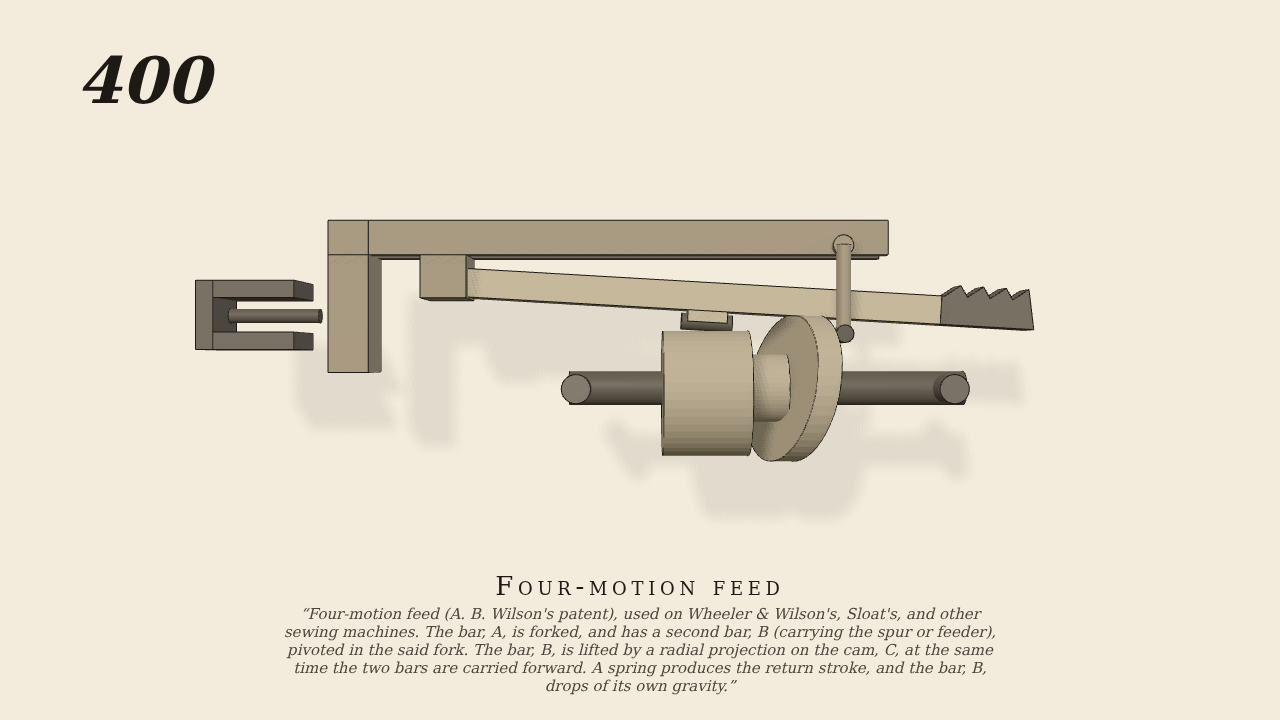
Four-motion feed (A. B. Wilson’s patent), used on Wheeler & Wilson’s, Sloat’s, and other sewing machines. The bar, A, is forked, and has a second bar, B (carrying the spur or feeder), pivoted in the said fork. The bar, B, is lifted by a radial projection on the cam, C, at the same time the two bars are carried forward. A spring produces the return stroke, and the bar, B, drops of its own gravity.
Only the input is driven; every other part of this model moves by physics (MuJoCo), and its ratios are measured. Run it live, change its parameters, or switch the friction off to see the output stop.
- Modelled as
- Side view with the cam's shaft across it. The cam C (the one driven joint, 30 rpm) carries a round set 0.5 cm off its shaft (Brown's radial projection) and an oblique face. A finger on the forked bar A bears on the oblique face, which carries A, and B pivoted in its fork, forward; a spring (a joint spring at A's down-turned end, in Brown's socket) draws them back. B's shoe rides on the round, which lifts the spur; B drops again by its own weight. The round's throw is a quarter turn from the face's, so the spur rises, goes forward, drops and comes back. Only the finger on the face and the shoe on the round touch.
- Measured
- A swings about 1.8 cm and B about 0.1 rad, both once a turn of the cam (period 2.13 s under load, within 0.06 s), and penetration stays under 2 mm.
- Notes
- A is drawn as a bar above B with its fork cheek round B's pivot; the cam's round and oblique face are two pieces on one hub rather than Brown's single profiled cam; the spring sits inside a cut-away socket (its stem drawn, no coil).
Film (MP4) · Still (PNG) · Spec (YAML) · Model (MJCF)