E. P. Brownell’s patent crank-motion to obviate dead-centers
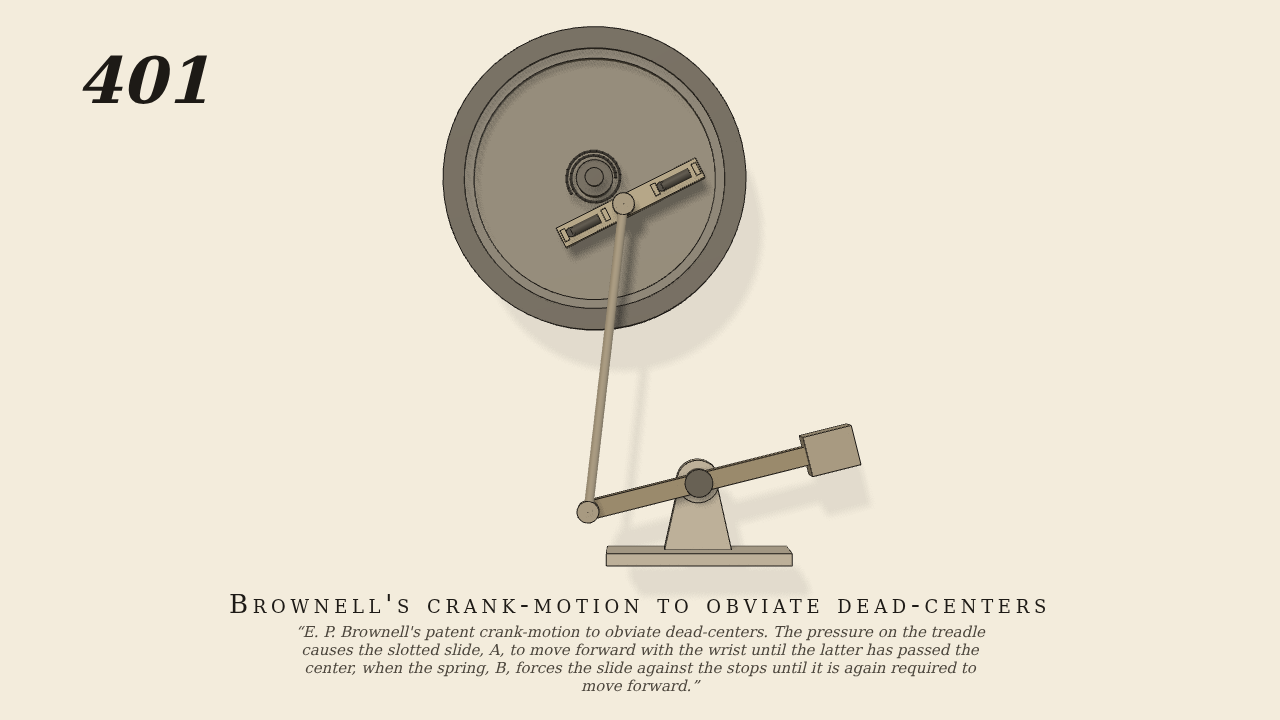
E. P. Brownell’s patent crank-motion to obviate dead-centers. The pressure on the treadle causes the slotted slide, A, to move forward with the wrist until the latter has passed the center, when the spring, B, forces the slide against the stops until it is again required to move forward.
Only the input is driven; every other part of this model moves by physics (MuJoCo), and its ratios are measured. Run it live, change its parameters, or switch the friction off to see the output stop.
- Modelled as
- Front of a treadle fly-wheel, Brown's figure. The wrist is not fixed in the wheel: it rides on slide A, slotted across the wheel off its centre, and spring B holds the slide out against its stops. The connecting-rod runs from the wrist down to the treadle; the foot on the treadle (the one driven joint) is the only input. The foot presses as a person would, at the right moment: a press-only push timed by the wheel's own angle (feet.timed on the wheel joint), so it pushes from just after the lower dead-centre round to the upper one. At a dead-centre the foot's pull runs along the rod into the slide and drives it in against the spring, carrying the wrist off the line of centres, so the wheel starts even from rest on the dead-centre; the spring then puts the slide back on its stops. Slide, stops and pins are real contact.
- Measured
- Starting from rest on the lower dead-centre, the wheel turns one way at 7.8 rad/s (74 rpm), never running back more than 0.0013 rad; the slide goes fully in (2 cm) at each lower dead-centre and comes back on its stops 15 times in 12 s; penetration 0.96 mm. With the slide locked the same foot leaves the wheel standing on the dead-centre (0.001 turns against 14.8); the same push on a fixed beat runs the wheel back (43 rad at 1.0 Hz, 3.7 rad at 1.4 Hz).
- Notes
- The bearing has a little friction (0.01 N m) so a wheel without the slide really stands on its dead-centre instead of being tipped off it by numerical noise. With Brown's slot the slide comes back on its stops at about 130 degrees past the dead-centre rather than at once. The foot's timing is the machine's own (the wheel's angle), a feature added for 394 and this movement (src: feet timed by a joint's position).
Film (MP4) · Still (PNG) · Spec (YAML) · Model (MJCF)