A method of repairing chains, or tightening chains used as guys or…
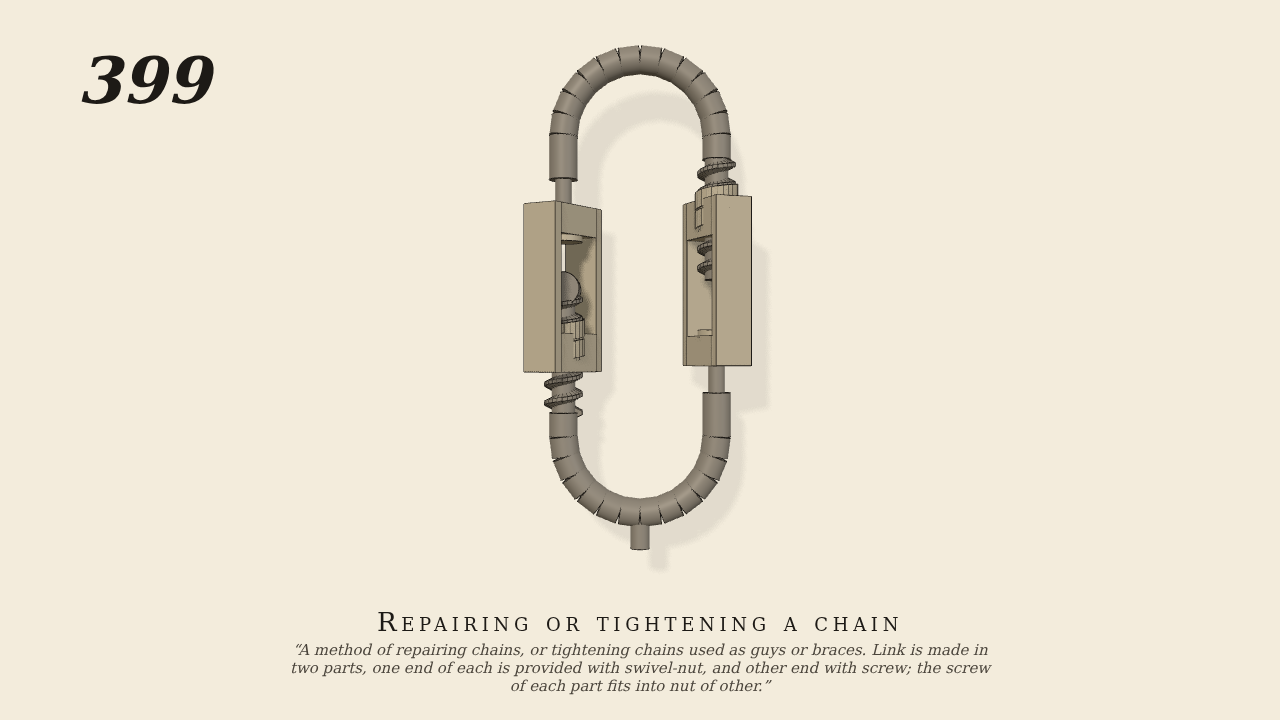
A method of repairing chains, or tightening chains used as guys or braces. Link is made in two parts, one end of each is provided with swivel-nut, and other end with screw; the screw of each part fits into nut of other.
Only the input is driven; every other part of this model moves by physics (MuJoCo), and its ratios are measured. Run it live, change its parameters, or switch the friction off to see the output stop.
- Modelled as
- A chain link made in two halves. The upper half (held by the chain above) has a swivel nut on its left leg and a right-hand screw (pitch 1.6 cm) on its right; the lower half is the other way about. Each nut is an oblong frame that turns on its leg's knob at one end and is tapped for the other half's screw at the other. The left nut is turned by a spanner (the one driven joint); its thread draws the lower half's screw up into it, and the right nut, free on its swivel, is turned by the right screw's thread as the lower half rises. Only the threads touch; the lower half hangs from them by its weight.
- Measured
- The lower half rises 0.2546 cm per radian of the left nut (one pitch a turn, within 3%), the right nut turns with it the other way (ratio -1.00 within 3%), and penetration stays under 2 mm.
- Notes
- Nuts drawn as oblong frames rather than Brown's rounded ones; the threads are left open to view; a stub stands for the chain below.
Film (MP4) · Still (PNG) · Spec (YAML) · Model (MJCF)