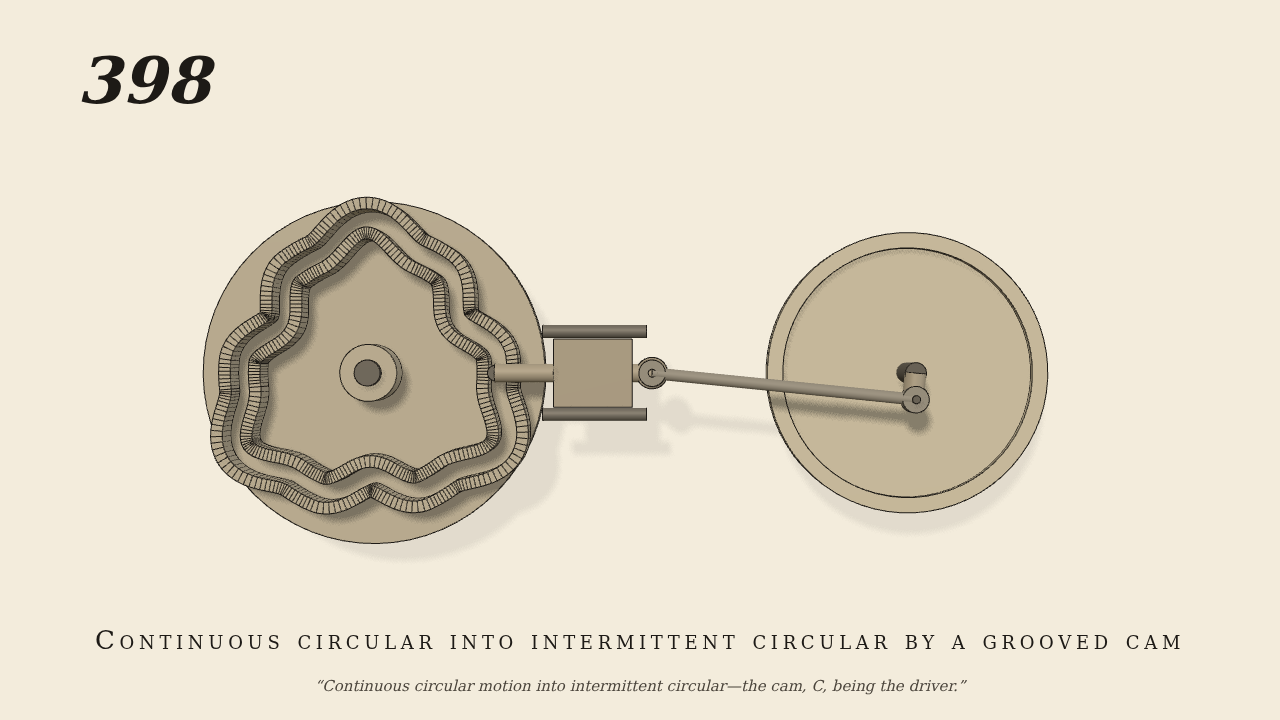
Continuous circular motion into intermittent circular—the cam, C,…
Continuous circular motion into intermittent circular—the cam, C, being the driver.
Only the input is driven; every other part of this model moves by physics (MuJoCo), and its ratios are measured. Run it live, change its parameters, or switch the friction off to see the output stop.
- Modelled as
- The cam C (the one driven joint, clockwise as Brown's arrow) has a three-lobed groove in its face; a pin on the slide runs in it, so the slide goes out and back three times a turn, each stroke in two halves with a short dwell between. A connecting rod from the slide turns the wheel's crank, whose throw is half the stroke, so each stroke gives the wheel half a turn and the wheel stops at every dwell with its crank square to the rod. At the ends of the stroke the slide turns back without stopping and the wheel's own way carries the crank over its dead centres, with the pin's clearance in the groove. The groove's walls are chains of capsules.
- Measured
- The wheel turns 3.0 times to the cam's once (within 2%), never runs back more than 0.1 rad, stands still (under 0.25 rad/s) through the dwells with its crank square, and penetration stays under 2 mm.
- Notes
- Brown does not show where the wheel stops; here the dwells are placed mid-stroke, where the crank cannot be turned back, so the groove's lobes carry small steps rather than Brown's smooth trefoil. Gravity is off (the machine lies flat).
Film (MP4) · Still (PNG) · Spec (YAML) · Model (MJCF)