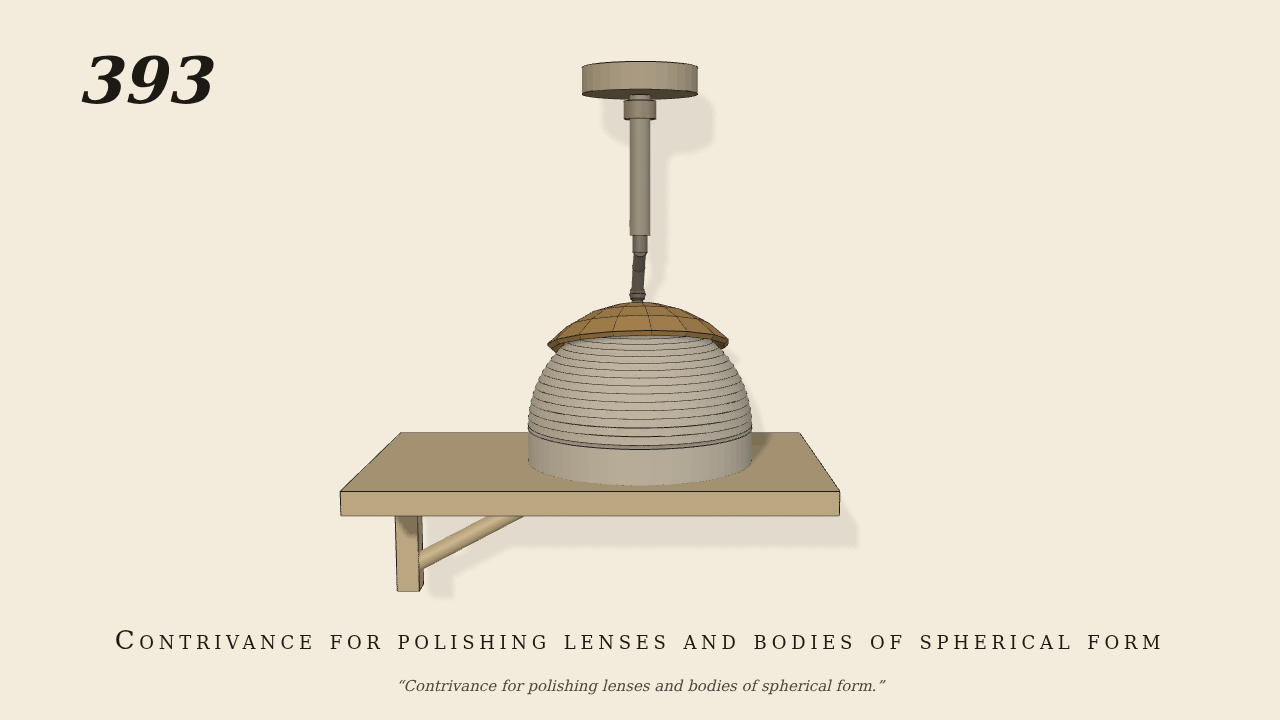
Contrivance for polishing lenses and bodies of spherical form
Contrivance for polishing lenses and bodies of spherical form. The polishing material is in a cup connected by a ball-and-socket joint and bent piece of metal with a rotating upright shaft set concentric to the body to be polished. The cup is set eccentric, and by that means is caused to have an independent rotary motion about its axis on the universal joint, as well as to revolve about the common axis of the shaft and the body to be polished. This prevents the parts of the surface of the cup from coming repeatedly in contact with the same parts of surface of the lens or other body.
Only the input is driven; every other part of this model moves by physics (MuJoCo), and its ratios are measured. Run it live, change its parameters, or switch the friction off to see the output stop.
- Modelled as
- The upright shaft, the only driven joint (30 turns a minute), turns concentric with the body polished, a sphere of 10 cm fixed on the bench. A bent arm, free to slide down in the shaft's socket so that its weight and the cup's press the cup on the work, carries the ball of the ball-and-socket joint 15 degrees off the shaft's axis. The joint is three hinges at the ball's centre (two crosswise, then the cup's own axis) with a little friction, and the cup bears on the work by capsule pads on its inner face, by real contact and friction.
- Measured
- The cup revolves about the common axis with the shaft and, turned by the rubbing alone, turns back on its arm at about 0.70 of the shaft's speed. Since the shaft carries it round at about 0.97 of that about its axis, the cup creeps round about its own axis at roughly a quarter of the shaft's speed, so the same parts of cup and work do not keep meeting. The cup rides on the work (the arm moves under 4 mm in its socket) and the deepest penetration is under 2 mm.
- Notes
- Brown gives no sizes. The ball-and-socket is three hinges at the ball's centre. The sphere is faceted (72 sides, 4 degree bands) and the cup touches it by 27 pads. The cup's own speed depends on the friction in its joint against the rubbing, which Brown does not give; with none at all the cup would barely turn in space. The bench and its bracket and the shaft's pulley are drawn only.
Film (MP4) · Still (PNG) · Spec (YAML) · Model (MJCF)