Gig-saw, the lower end connected with a crank which works it, and…
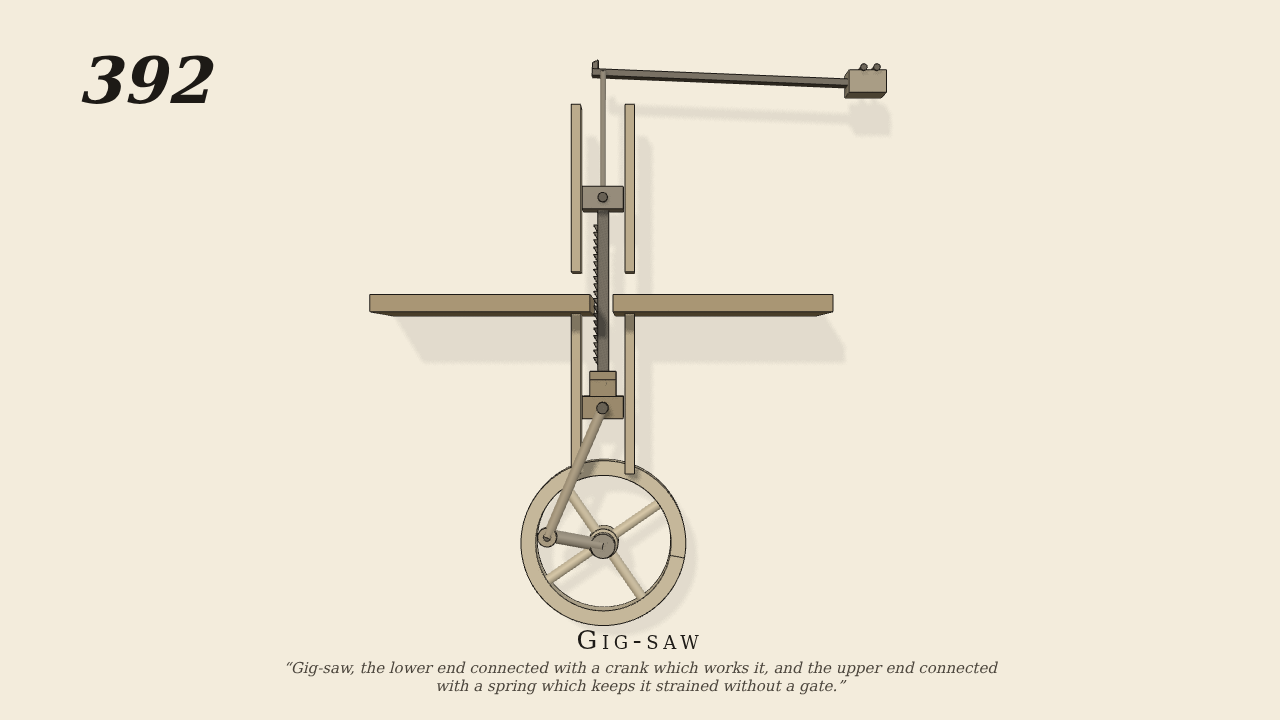
Gig-saw, the lower end connected with a crank which works it, and the upper end connected with a spring which keeps it strained without a gate.
Only the input is driven; every other part of this model moves by physics (MuJoCo), and its ratios are measured. Run it live, change its parameters, or switch the friction off to see the output stop.
- Modelled as
- A crank of 6 cm on the wheel's shaft, the only driven joint (40 turns a minute), works the lower crosshead up and down in its guides under the table by a 15 cm connecting rod. The blade is fast in the upper crosshead, which slides in guides above the table and hangs by a link from the end of the spring, a leaf clamped at its far end (a stiff bar on a sprung hinge at the clamp, 6.5 N·m/rad, set 0.65 rad). The blade's lower end carries a cross-pin under the hook of the lower crosshead, a real contact: the crank pulls the blade down by the hook, and only the spring draws it up again.
- Measured
- The lower crosshead strokes 12 cm (amplitude 6 cm) and the blade with the upper crosshead keeps with it both ways (slope 1.0, r² over 0.999), so the blade stays in tension through the whole turn without a gate. The leaf works between about −0.15 and +0.22 rad of its 0.65 rad set, so it is always strained. Deepest penetration is under 1.5 mm.
- Notes
- Brown gives no sizes; they are scaled from his figure, with the wheel 9 cm in radius. The leaf spring is modelled as a stiff bar on a sprung hinge at its clamp, so it swings rather than bends. The blade cannot push: it is drawn down only by the hook and up only by the spring. The table, guides, clamp and the wheel's rim and spokes are drawn only.
Film (MP4) · Still (PNG) · Spec (YAML) · Model (MJCF)