Device for converting oscillating into rotary motion
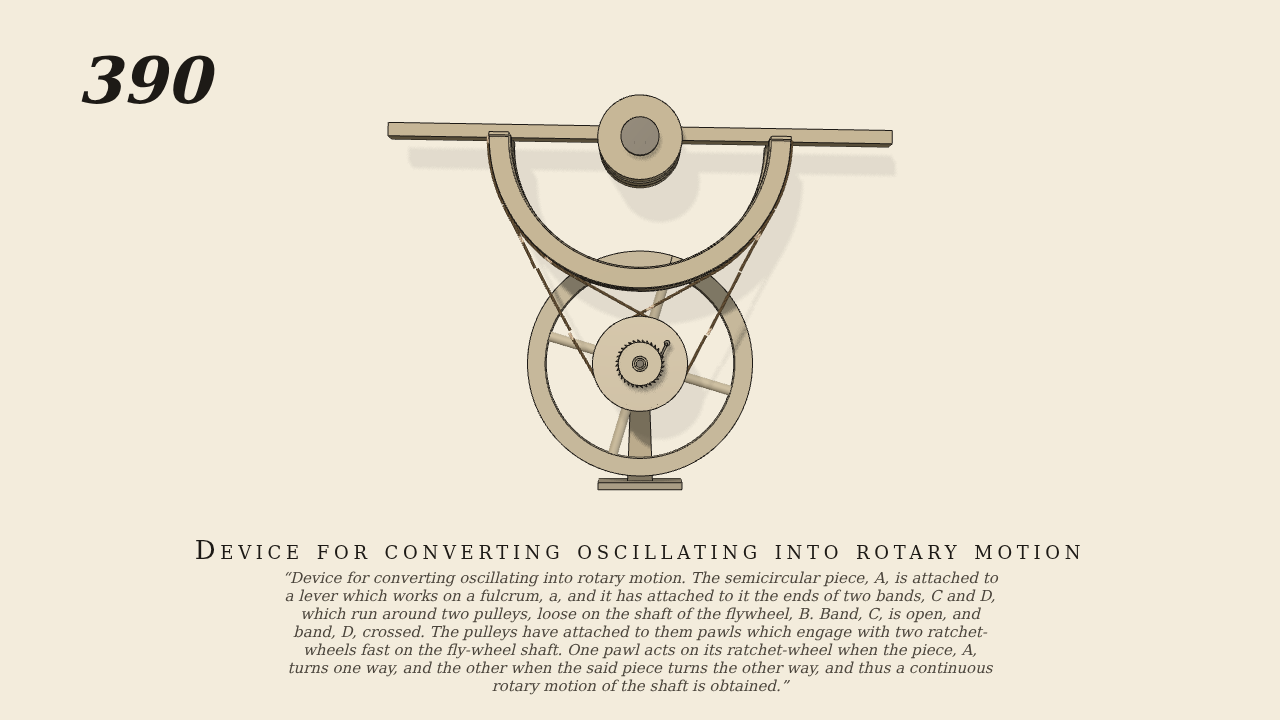
Device for converting oscillating into rotary motion. The semicircular piece, A, is attached to a lever which works on a fulcrum, a, and it has attached to it the ends of two bands, C and D, which run around two pulleys, loose on the shaft of the flywheel, B. Band, C, is open, and band, D, crossed. The pulleys have attached to them pawls which engage with two ratchet-wheels fast on the fly-wheel shaft. One pawl acts on its ratchet-wheel when the piece, A, turns one way, and the other when the said piece turns the other way, and thus a continuous rotary motion of the shaft is obtained.
Only the input is driven; every other part of this model moves by physics (MuJoCo), and its ratios are measured. Run it live, change its parameters, or switch the friction off to see the output stop.
- Modelled as
- The lever and the semicircular piece A (rim radius 20 cm) rock on the fulcrum a, the only driven joint (a velocity servo of its own swing, ±0.3 rad at 0.4 Hz). Two bands (0.4 cm round cords) are made fast at A's tips and lie on A's rim, which they leave on tangents: C runs open round pulley C, D crossed round pulley D, its two ends 2.4 cm apart across A so the strands pass each other where they cross. The pulleys (5.8 cm) turn loose on the fly-wheel shaft 30 cm below. Each carries a sprung pawl that engages a 32-tooth ratchet fast on the shaft, both set the same way; the fly-wheel B (16 cm) is on the same shaft and carries a light load. The bands drive the pulleys only by contact and friction, and the pawls work by real contact.
- Measured
- Each pulley follows A both ways at about 3.37 times A's angle, which is A's rim over the pulley's on the bands' centre lines. Pulley C (open band) turns with A and D (crossed band) against it. The fly-wheel turns one way on both strokes at about 2 rad/s, never running back more than 0.05 rad, while each pawl clicks back over its teeth on its idle stroke. Deepest penetration is under 2.5 mm.
- Notes
- Brown gives no sizes. A is modelled as two grooves, each made of two quarter arcs on the rocker, without flanges, as he draws it. The open band C has less wrap on its pulley than the crossed one and creeps on it by a few per cent a stroke, so its follow fit is looser (r² ≥ 0.93). The pawl of D sits behind its pulley, so it is hidden in the front view. A pedestal behind the fly-wheel carries the shaft, and the fulcrum is a bare pin.
Film (MP4) · Still (PNG) · Spec (YAML) · Model (MJCF)