Lifting-jack operated by an eccentric, pawl, and ratchet
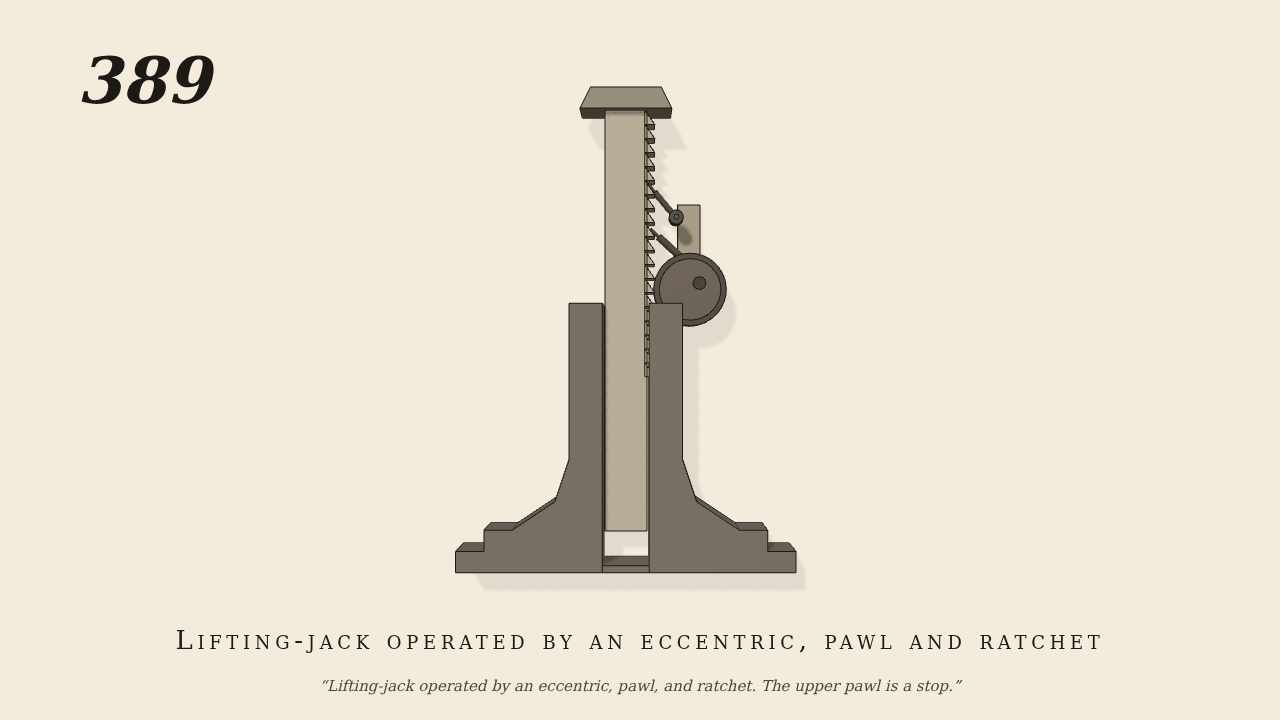
Lifting-jack operated by an eccentric, pawl, and ratchet. The upper pawl is a stop.
Only the input is driven; every other part of this model moves by physics (MuJoCo), and its ratios are measured. Run it live, change its parameters, or switch the friction off to see the output stop.
- Modelled as
- Gravity on. A rack-bar 6 cm wide, with ratchet teeth of 2 cm pitch on its right face (level lower faces, sloping upper ones), slides up and down in the bore of the stock and carries its head and load, 4 kg in all. An eccentric (radius 4.4, throw 1.6 cm each way) turns on a shaft in the stock's top at 20 rpm, the only driven joint. Its strap is free on it, and its arm is the lifting pawl, whose point lies on the teeth by the strap's own weight. The stop pawl hangs on a pin in a bracket above, its point also on the teeth by its weight. Both points meet the teeth in real contact.
- Measured
- The rack rises one tooth a turn: 2.0 cm per turn of the eccentric (ratio 0.00318 m/rad, within 5%), 10 cm in 16 s. Each turn it overshoots by about 1 cm and drops back onto the stop, never further than that (monotonic within 1.5 cm). The stop clicks over a tooth every turn, and the deepest penetration is under 2 mm.
- Notes
- Brown gives no sizes. The pawls' points are short capsules at the ends of straight arms, not his curved hooks, and are pressed onto the teeth by their weight, not by springs. The stop's pin and the eccentric's shaft are carried by a bracket drawn behind; the stock is drawn and does not collide, the rack being held in its bore by a slide joint.
Film (MP4) · Still (PNG) · Spec (YAML) · Model (MJCF)