Reciprocating into rotary motion
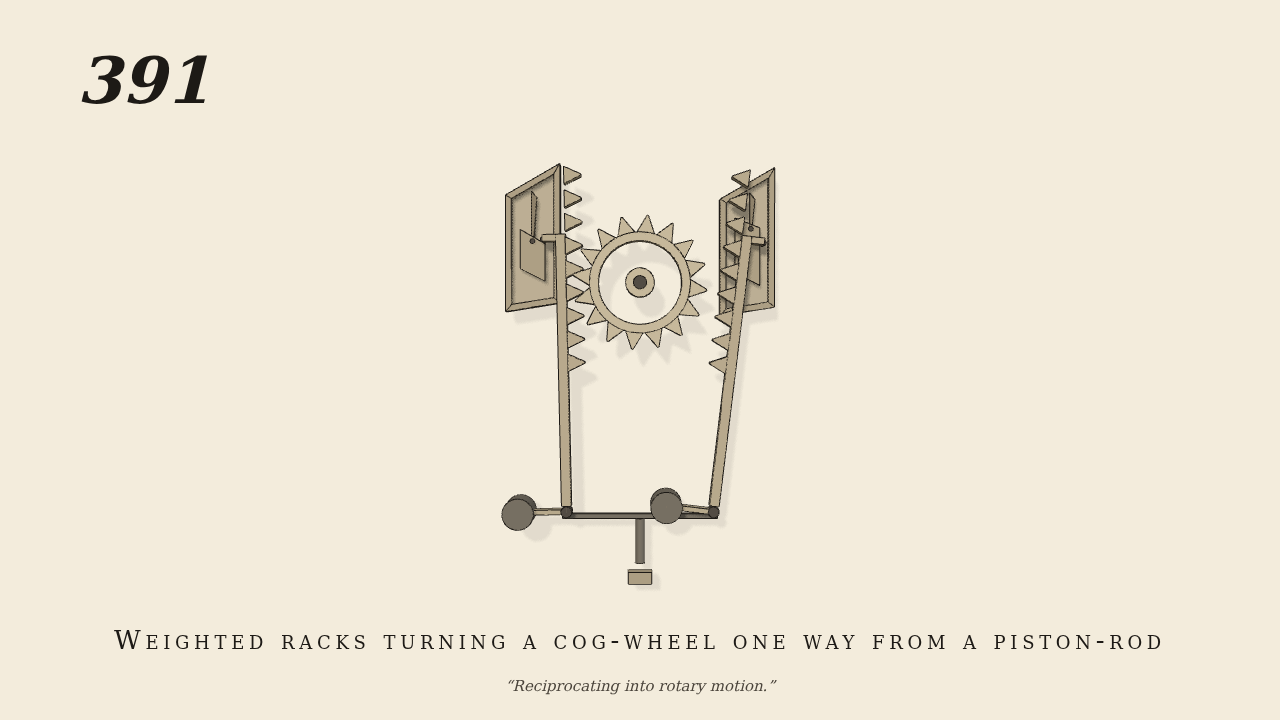
Reciprocating into rotary motion. The weighted racks, A, A1, are pivoted to the end of a piston-rod, and pins at the end of the said racks work in fixed guide-grooves, b, b, in such manner that one rack operates upon the cog-wheel in ascending and the other in descending, and so continuous rotary motion is produced. The elbow lever, C, and spring, d, are for carrying the pin of the right-hand rack over the upper angle in its guide-groove, b.
Only the input is driven; every other part of this model moves by physics (MuJoCo), and its ratios are measured. Run it live, change its parameters, or switch the friction off to see the output stop.
- Modelled as
- Brown's elevation, gravity on. The piston-rod's crosshead (the one driven joint, up and down 18 cm, 0.2 strokes a second) carries the weighted racks A (left) and A1 (right) on pivots a, either side of a 16-tooth cog-wheel (module 1.25). A pin on an arm at each rack's top runs in a fixed groove b round a D-shaped island: the left pin goes up the outer side (rack off the wheel) and down the inner (in mesh), the right pin up the inner side (in mesh) and down the outer, so one rack turns the wheel in descending and the other in ascending, the same way. Each groove's head slopes the pin across, and a spring catch (Brown's elbow lever C and spring d) lets the pin over the upper angle and keeps it from going back. Pins in grooves, teeth on teeth and pins on catches are all real contact.
- Measured
- From rest the wheel turns one way only (largest run-back 0.13 rad, the teeth's play), about 1.6 rad to each stroke of the rod (a whole 18 cm stroke in mesh would give 1.8 rad at the 10 cm pitch radius; each rack swings into mesh over the first ~2 cm), a mean 0.63 rad/s (6 rev/min). Penetration under 0.6 mm. With the grooves out of contact both weighted racks hang in gear, the rod saws them up and down and the wheel only rocks (0.1% of the working headway).
- Notes
- The grooves are short trapezoids round the racks' tops rather than Brown's tall D-grooves beside the racks; the rack teeth are pointed (narrow tips, for clean entry) not square; a spring catch is fitted at both grooves' heads (Brown has the elbow lever C and spring d on the right only); the catch is a sprung flap rather than an elbow lever.
Film (MP4) · Still (PNG) · Spec (YAML) · Model (MJCF)