Tread-wheel horse-power turned by the weight of an animal…
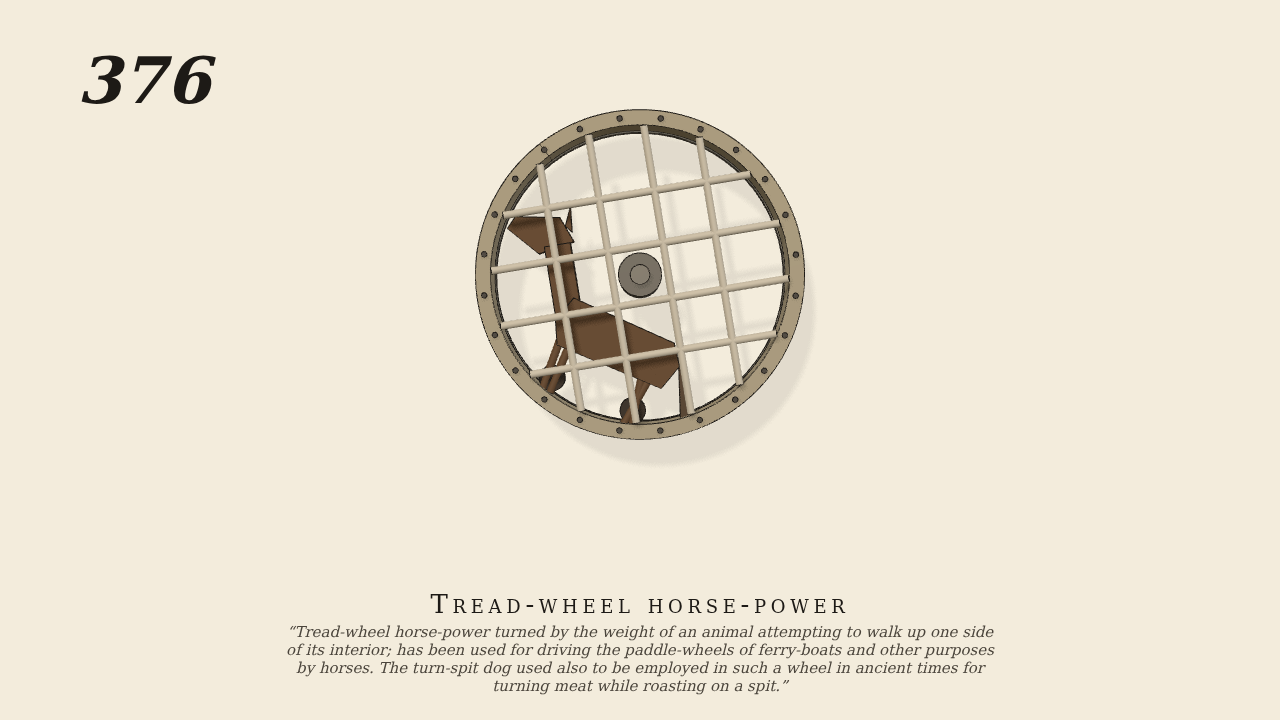
Tread-wheel horse-power turned by the weight of an animal attempting to walk up one side of its interior; has been used for driving the paddle-wheels of ferry-boats and other purposes by horses. The turn-spit dog used also to be employed in such a wheel in ancient times for turning meat while roasting on a spit.
Only the input is driven; every other part of this model moves by physics (MuJoCo), and its ratios are measured. Run it live, change its parameters, or switch the friction off to see the output stop.
- Modelled as
- The wheel is 14 cm in radius to its tread (the inside face of the rim) and turns on a fixed axle against the load it drives, taken as a resistance of 1.0 N m per rad/s (the paddle-wheels). The horse (2 kg) stands free inside it, low on the left-hand side: it may slide and pitch, and nothing holds it but the tread. Its walking is the only driven part: a 1.2 cm roller under its hind hooves turns at 110 rev/min against the tread, while its fore hooves ride on a free roller.
- Measured
- The horse climbs a little way up the side and stays there, both feet down and nearly level, while the wheel goes round under it at 0.0857 of the hooves' roller speed (about 9.4 rev/min), the ratio of the radii: the tread is carried by friction alone and does not slip. The weight of the horse, standing out to the side of the axle, is what turns the wheel against its load.
- Notes
- Brown gives no sizes. The horse is a flat silhouette drawn larger than its stance, and its walking is a driven roller under its hind hooves; the bars across the wheel's face and the rim's bolts are drawn only, and the wheel's stand is left out as in the figure.
Film (MP4) · Still (PNG) · Spec (YAML) · Model (MJCF)