The tread-mill employed in jails in some countries for exercising…
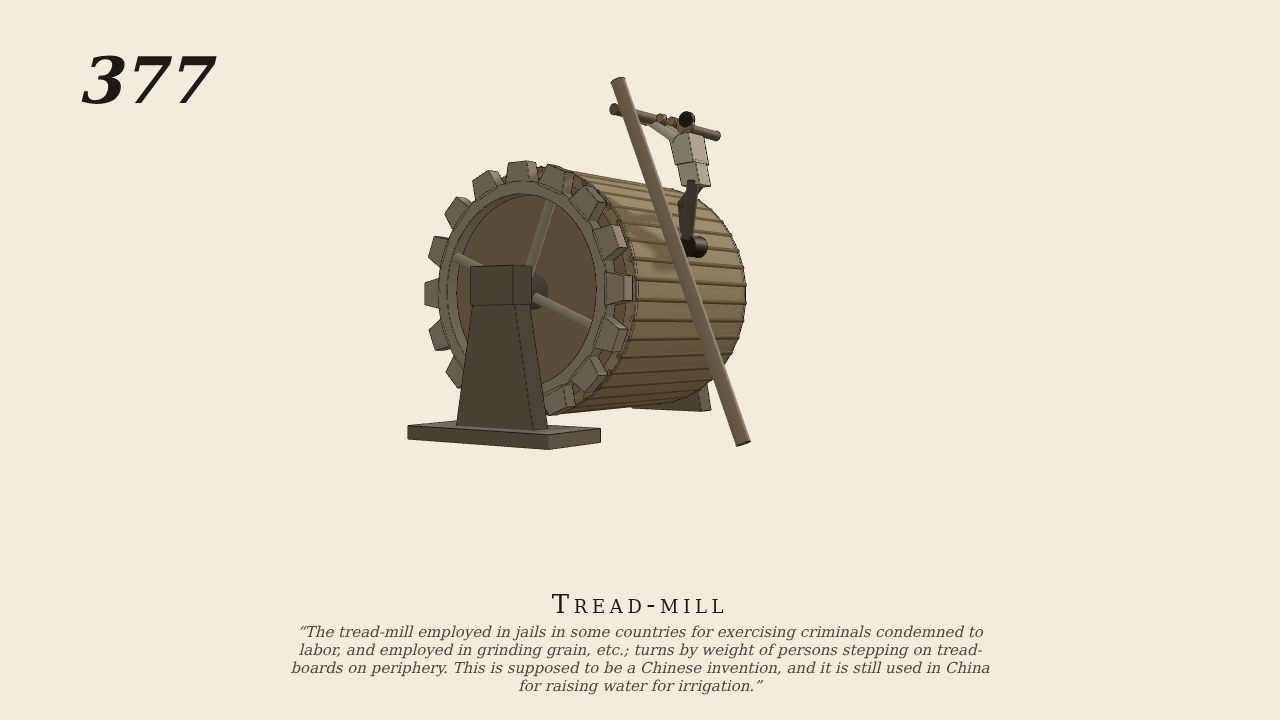
The tread-mill employed in jails in some countries for exercising criminals condemned to labor, and employed in grinding grain, etc.; turns by weight of persons stepping on tread-boards on periphery. This is supposed to be a Chinese invention, and it is still used in China for raising water for irrigation.
Only the input is driven; every other part of this model moves by physics (MuJoCo), and its ratios are measured. Run it live, change its parameters, or switch the friction off to see the output stop.
- Modelled as
- The drum is 14 cm in radius to its boards and 24 cm long, and turns on a fixed axle against the work it drives, taken as a resistance of 1.0 N m per rad/s; the spur-wheel on its end, which in the figure gives the power off, is part of it. The man (2 kg) stands on the boards a little before the top, holding the hand-rail: he may move forward and back and up and down, and nothing holds him there but the boards and the rail. His stepping is the only driven part: a 1.2 cm roller under his feet turns at 110 rev/min against the boards.
- Measured
- The man keeps his place at the rail while the drum goes round under him at 0.0857 of the roller's speed (about 9.4 rev/min), the ratio of the radii, carried by friction alone without slipping. It is his weight on the boards, out to the side of the axle, that turns the drum against its load.
- Notes
- Brown gives no sizes. The man is a simple block figure, and his stepping is a driven roller under his feet; his hands grip the rail on both sides. The boards, the spur-wheel's teeth, the pedestals and the slanting post are drawn only.
Film (MP4) · Still (PNG) · Spec (YAML) · Model (MJCF)