Robert’s contrivance for proving that friction of a wheel carriage…
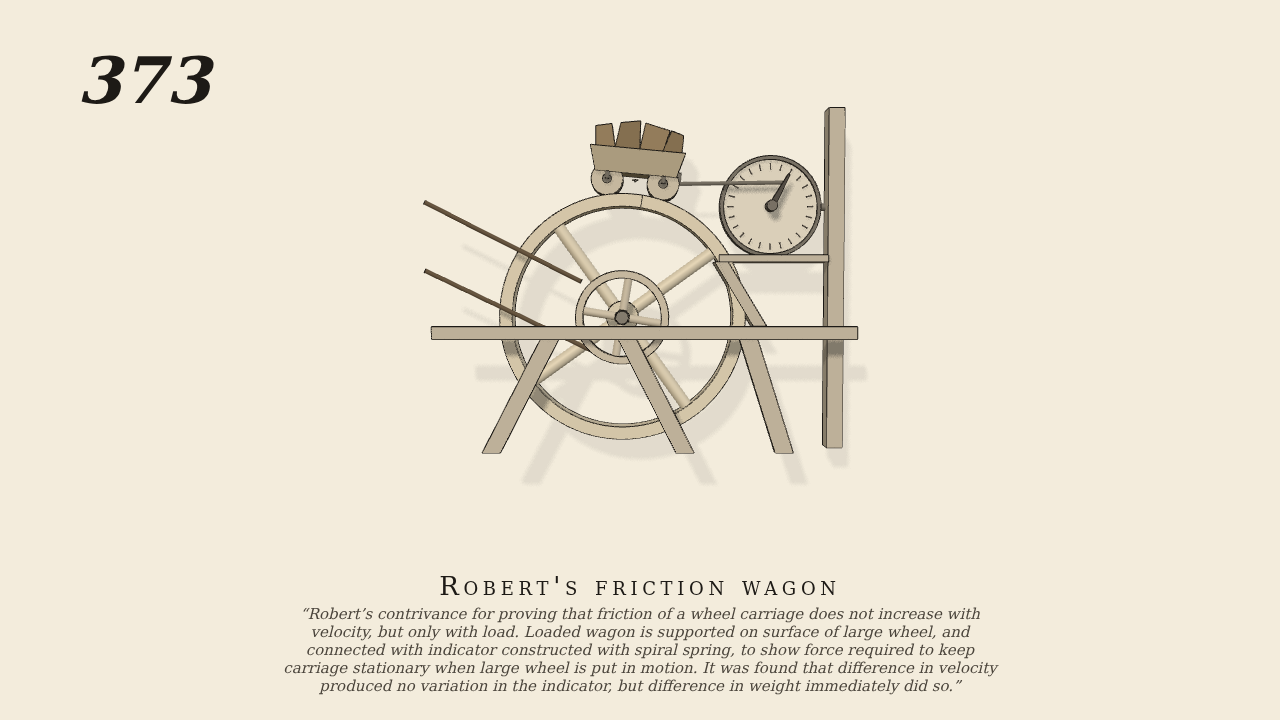
Robert’s contrivance for proving that friction of a wheel carriage does not increase with velocity, but only with load. Loaded wagon is supported on surface of large wheel, and connected with indicator constructed with spiral spring, to show force required to keep carriage stationary when large wheel is put in motion. It was found that difference in velocity produced no variation in the indicator, but difference in weight immediately did so.
Only the input is driven; every other part of this model moves by physics (MuJoCo), and its ratios are measured. Run it live, change its parameters, or switch the friction off to see the output stop.
- Modelled as
- The large wheel, 14 cm in radius, turns on its shaft at 20 rev/min and is the only driven part. The loaded wagon, 3 kg, stands on the top of its rim on two axles with wheels of 1.8 cm radius, free to rise, fall and pitch; each axle turns against a friction of 0.05 N m in its bearings. A rod from the wagon goes to the 3 cm arm of the indicator, whose arbor is held by a spiral spring of 0.5 N m/rad.
- Measured
- The rim rolls the wagon's wheels round beneath it (measured -7.72 against -7.78 from the radii) while the wagon stays in place. The indicator is carried round and stands at 0.505 rad (28.9 degrees), steady to a hundredth of a degree: a pull of 8.4 N at the arm. About 5.6 N of it is the axle friction (2 x 0.05 / 0.018); the rest is the wagon's weight drawn off the crown of the wheel by its 1.5 cm displacement. Contact penetration stays under 0.1 mm.
- Notes
- Brown gives no sizes. The wheel runs at one speed only, so the model does not show his finding that speed makes no difference, and its axle friction is a fixed torque that does not grow with the load.
Film (MP4) · Still (PNG) · Spec (YAML) · Model (MJCF)